|
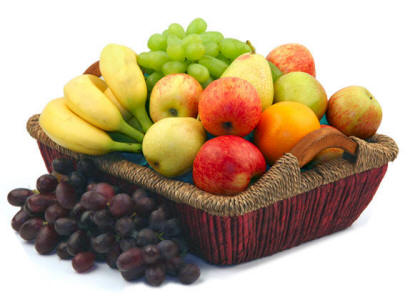

The relationship between the human species and the fruits of
flowering plants is far older even than the human species itself. The skulls of
the earliest hominids testify to the fact that they were omnivores. They had
teeth specialized for the chewing of plant material as well as teeth designed
for the ripping and tearing of animal flesh, just like we do. Along with animals
(including insects), fruits were the primary constituents of our earliest
ancestor's diets. Fruits were the first plants cultivated by humans as well.
Early humans practiced the age-old arts of hunting and gathering.
This survival strategy requires a nomadic lifestyle as even a small population
of humans will quickly strip almost any terrain bare of naturally occurring
nutrition after a short time, and so they were required to move on every once in
a while. Eventually they would return to the area they had foraged a few years
earlier, and they must have been surprised to find a lush garden growing where
their old potty used to be. Thus began agriculture.
They quickly learned that it was easier to plant a few fruit
trees than to constantly go off searching for more. The seeds of most fruits are
easy to germinate, require little or no active cultivation given proper growing
conditions, and many will produce fruit for generations. Fruit-bearing plants
produce a prodigious amount of caloric output (pronounced "food") relative to
their small requirement for caloric input (pronounced "labor"), so the
cultivation of fruits produces more return on investment than any other survival
strategy. The days of nomadic foraging were a thing of the past. Thank goodness.
I say thank goodness because this new technology, which we now
call agriculture, motivated people to stay put long enough to actually
accomplish something. It allowed them to domesticate wild animals which could be
pastured and penned, a tricky proposition for any tribe of nomads whose animals
surely would have wandered off in search of food while their masters were busy
wandering around looking for food of their own. It allowed the development of
small villages, which grew into towns, and eventually into cities. This led to
the development of trading centers and the beginnings of commerce. It freed
people from the all-consuming effort to get enough to eat every day and allowed
them to pursue other interests. This specialization resulted in the development
of the arts, new technologies, organized religion, governmental and military
organizations, and every type of professional endeavor. All these factors
combined to form what we know as civilization, and it all began with the
planting of a few fruit trees. The rest is, quite literally, history.
You Say Tomato, I Say... Vegetable
Any botanist will tell you that a tomato is a fruit because,
according to the technical definition, a fruit is the seed-carrying organ, or
ovary, of a flowering plant, or angiosperm. And any child will tell you that a
tomato is a vegetable because... well, just because.
For the purpose of this article, I'm with the kid. Yes, I know
that tomatoes (and peppers, squashes, and eggplants, to name just a few) are
really fruits, but I'm writing this thing for cooks, not for botanists. Every
cook knows the difference between a fruit and a vegetable, and that is the
standard I will be using here.
What distinguishes fruits from vegetables in the cook's mind is
the inherent natural sweetness of fruits, and even though there is no denying
the many great savory dishes that are made with fruits of many kinds, everyone
knows that fruits usually arrive at the dinner table in the form of a dessert.
Apples, oranges, peaches, and pears all make wonderful sweet concoctions, and
although many vegetables can be used to make similar sweets, it isn't their
natural tendency. Who wants another scoop of eggplant ice cream? See what I
mean?
Fortunately, the vast majority of the things we think of as
fruits are really and truly fruits. All of the fruits in your supermarket (with
the exception of rhubarb) are actually the seed-bearing organs of the plants
they came from, so you can expect to see them included in the Dictionary of
Fruits. You will not find entries for such things as tomatoes, and squashes
there because, even though they are technically fruits, they will be dealt with
"All About Vegetables." Please stay tuned.
So there. I'll say it one more time: for the purpose of this
essay, things that are technically fruits but are treated as vegetables by cooks
will not be included in this essay because... well, just because.
Buying Fruits
Most of the readers of this article are fortunate to live in
places where many fresh fruits are available year round, regardless of whether
they are "in season" or not. We owe this to the international commerce in fruits
and other produce which allows North Americans to have fresh peaches in January
and Australians to have fresh strawberries in August. Thanks to advances in
breeding, harvesting, storing, and transportation, fresh fruits make their way
from the orchards of the southern hemisphere to the northern hemisphere while it
suffers through the colder months, and vice versa. The ability to transport
fresh produce over such great distances and have it arrive ready for market was
considered economically unfeasible, if not technically impossible, only a few
decades ago, and this is truly one of the more remarkable, yet often overlooked,
accomplishments of our modern society.
However, as much as I enjoy the luxury of having fresh mangos,
peaches, pears, and grapes available whenever I want them, I also know that the
best (and least expensive) produce arrives in my markets when it is in season in
my own hemisphere, and the best of those are grown as close to my home as
possible. This is because, in spite of the miraculous advances in technology
that I already mentioned, there is just no fruit better than fresh fruit,
ripened in the field and still warm from the sun.
The moral here is simple: buy the freshest locally grown fruits
available in your area. Farmer's markets, roadside stands, and many small,
independently owned groceries offer the best of locally grown fruits. Even if
they aren't grown within several thousand miles (many, many kilometers) of your
location, the best quality fruits will be available during their natural
season-fresh strawberries will always be best in spring, regardless of where
they are grown.
When buying fruits, keep in mind that most of them will continue
to ripen after you have bought them. I usually buy two or three bananas from a
ripe bunch, and two or three from a green bunch because I don't want them all to
be at their peak at the same time. Many other (but not all) fruits continue to
ripen after they have been picked, including apricots, melons, mangos, papayas,
peaches, pears, nectarines, persimmons, plums, and to a lesser degree,
strawberries and pineapples.
I give specific information on individual fruits as appropriate
in the Dictionary of Fruits, but the conventional wisdom dictates that we should
buy fresh fruits in season and from local growers whenever possible. Buy fresh
fruits often and in small quantities to avoid spoilage and waste, and store them
under optimal conditions.
Storing Fruits
The objective in storing fruit is to maintain it in its edible
state until we are ready to eat it. In other words, if it spoils before we are
ready to eat it, we have failed. So let's take a look at fruit spoilage, okay?
Fruits spoil because of two processes. The first is the result of
microbial activity, and the microbes in question are primarily molds and, to a
lesser degree, bacteria. These things are in the air around us, and all they
need is a nice warm place with plenty of water and sugar to launch an invasion
on an unsuspecting fruit.
The skin is the fruit's primary defense against microbial
invasion, and this is why it is so important to treat ripe fruits with care. The
slightest bruise or breach of the skin will provide a foothold for the
microscopic invaders, and once they have established themselves in any small
section of the fruit, their ultimate conquest of the entire fruit is assured.
This fuzzy green invasion will spread and the armies of microbes will grow and
ultimately overtake nearby fruits if not controlled, and this is exactly how one
bad apple spoils the whole barrel.
The action of enzymes and other chemical processes in the fruit
also leads to spoilage, only this type of spoilage is more commonly thought of
as over-ripening. It is characterized by the fruit becoming discolored, soft
(often mushy), and with a distinctly "off" (and often slightly alcoholic) flavor
and aroma. Either way, spoiled fruit is not good. Both of these processes are
slowed dramatically by refrigeration, but refrigeration also stops the ripening
of fruits that aren't quite ready to eat. So what should we do with the fruit we
bring home?
I'm glad you asked. Fruits should be stored at room temperature
until they are ripe. Storing them in a loosely closed paper bag will speed the
ripening process, and including an apple in the bag will further hasten ripening
due to the ethylene gas that apples (and most other fruits) produce. No one is
quite sure how the ethylene does this, but it does.
Once they are ripe, fruits should either be eaten or
refrigerated. Store fruits in a loosely closed paper bag-plastic bags will
retain moisture and speed the spoiling process-in the bottom of the
refrigerator. The vegetable crisper drawer in most refrigerators is ideal for
this purpose. Most fruits will keep for weeks, and apples will keep for up to
six months, if properly refrigerated. Even bananas will stop ripening in the
refrigerator, and although the skin will turn black, ripe bananas will remain
firm for several days beyond their normal life expectancy.
Due to the high water and sugar content of most fruits, they are
also excellent candidates for freezing. Whether frozen whole or cut into small
pieces, they will keep for several months if frozen in airtight containers or
plastic bags. Be aware that the expansion of the water in the cells of the
fruits will cause cellular damage and the thawed fruit will have lost the
crispness of the original. As a result, thawed frozen fruit is not ideal for
eating raw, but it can be cooked and treated exactly like fresh fruit in baking
and making preserves with excellent results.
Finally, you should never wash your fruit when you bring it home
from the store. Even brief exposure to water will leach vitamins and sugars from
the fruit (especially berries), and washing will remove the natural and man-made
protective coatings on many fruits, thus making them more vulnerable to
microbial invasion. Residual water will also create the ideal environment for
spoilage, so wash your fruit just before you eat it.
Preserving Fruits
Preserved fruits have been an important part of our diet for
thousands of years, especially in colder northern climates where preserving and
storing foods of all kinds was necessary to survive the harsh winters. Over the
ages many methods of preserving fruit have been developed by people from all
climates eager to extend the availability of fruits beyond their short natural
season.
The high sugar content of most fruits makes them excellent
candidates for many types of preservation, but their high water content also
makes them excellent candidates for spoilage, as we have already discussed. Most
methods for preserving fruits, therefore, aim to eliminate as much of their
water content as possible. A thorough discussion of these various techniques is
beyond the scope of this article, and I suggest that you consult a good cookbook
devoted to the subject for complete instructions on preserving fruits.
That said, here is a quick look at the many methods of preserving
fruits:
Dried Fruits - Many fruits, including apples, pears. peaches,
nectarines, apricots, figs, grapes, berries, and bananas can be dried and stored
almost indefinitely. Apples should be peeled, cored, and thinly sliced before
drying. Pears and stone fruits such as peaches need only be halved and cored or
pitted, and bananas should be peeled and thinly sliced prior to dehydration.
Grapes, figs, and berries can be dried whole. Commercial dehydrators are
available to the home cook, but you don't need a special appliance to dry fruits
at home. You can place the prepared fruits on a wire rack and dry them in an
oven set on the lowest setting.
Fruit Leathers - A variation on drying, any fruit can be peeled,
seeded, and puréed in an electric blender or food processor. The resulting purée
is then spread in a thin layer on parchment or wax paper and air dried or dried
as described above.
Candied Fruits - Also known as crystallized or glace fruits, this
process involves cooking fruits in a sugar syrup before drying. Suitable fruits
included citrus (both the flesh and rinds), stone fruits, and pineapples.
Fruit Jams, Jellies, and Preserves - Most fruits can be cooked
with sugar (and sometimes some pectin to aid thickening) to make jams, jellies,
and preserves. If done properly and stored in sterilized containers, these will
last almost indefinitely. They can be eaten as spoon sweets or used as toppings
for toast or bread and as fillings for pastries. Jellies are made only with the
juice of the fruits, while jams and preserves are made from the entire fruit.
The difference between jams and preserves varies depending on whom you ask, but
the general consensus is that preserves have larger pieces of fruit than jams,
which are more like a fruit purée.
Fruits in Alcohol - Eighteenth century seafarers discovered that
the fruits they were transporting could be preserved in barrels of rum during
their long voyages. Any fruit can be preserved if stored in an airtight
container and covered with rum, brandy, vodka, or other distilled spirit. These
will last for many months, and new fruits can be added to the container as its
contents are consumed.
Pickled Fruits - Pickling fruit is largely a forgotten art, but
in the past many fruits were preserved in a sweet vinegar solution, often with
spices such as cloves and cinnamon added. Suitable fruits include stone fruits,
figs, berries, and of course, watermelon rind.
The
Dictionary of Fruits
Before I begin the Dictionary of Fruits, let me state that I
believe it may be the most comprehensive listing of fruits ever compiled by
anyone anywhere. Now let me qualify that remark.
More than 230,000 species of angiosperms (flower-bearing plants,
remember?) have been identified by scientists, and I'm sure there are a few the
scientists haven't gotten around to yet. Therefore, to assemble a truly
comprehensive list of fruits would be beyond the ability even of people much
smarter than me who work much harder (and for up to eight hours in a single
day!) than I do. I like to call these super achievers "normal people."
We have also agreed that many fruits won't be included here
because they are fruits that we think of as vegetables. Actually, I decided that
all by myself, but since I'm the guy tapping away at the keyboard, we're going
to go with it. So if you want to know all about things like tomatoes, zucchini,
and eggplants, you're just going to have to wait until I write "All About
Vegetables." Okay?
There is another class of plant products which might be
considered for inclusion in the Dictionary of Fruits that I haven't addressed
yet. Nuts definitely qualify as fruits in the sense that they are all parts of
the fruit of the plants that produce them. However, botanically speaking, some
of the things we call nuts are actually drupes (walnuts and almonds), legumes
(peanuts), and seeds (Brazil nuts), and amid such confusion, I have chosen to
eliminate them from consideration here. There may be a future article titled
"All About Nuts," and there might not be. No one knows for sure.
So, now that I have eliminated about 229,900 of the fruits known
to science, we'll focus on the 100 or so fruits remaining-those that are
commonly eaten by people. Even this statement requires some qualification
because I know that right now, on some remote mountain top in Borneo or on the
banks of an uncharted stream in the Amazon, somebody is eating a ripe, juicy
fruit that you and I will never hear of. We're just going to have to live with
that.
The Dictionary of Fruits will list all those fruits that are
commonly known as fruits (not vegetables, not nuts) and which are available to
one degree or another to my readers. When the guy in Borneo gets an email
account, then I'll worry about the fruit he's eating.
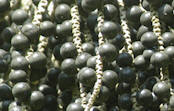 Açaí
- The fruits of a the palm tree Euterpe oleracea that is found growing
throughout the tropical regions of Central and South America. It is an important
source of food in its native range, and the juice of the berries is widely
consumed. The tree has been a source of high-quality hearts of palm for decades,
but recently the berries have become the most important commercial product of
the tree due to several purported health benefits. There is no scientific
evidence that açaí consumption affects body weight, promotes weight loss. or has
any positive health effect. Açaí
- The fruits of a the palm tree Euterpe oleracea that is found growing
throughout the tropical regions of Central and South America. It is an important
source of food in its native range, and the juice of the berries is widely
consumed. The tree has been a source of high-quality hearts of palm for decades,
but recently the berries have become the most important commercial product of
the tree due to several purported health benefits. There is no scientific
evidence that açaí consumption affects body weight, promotes weight loss. or has
any positive health effect.
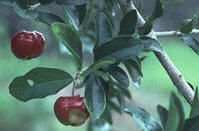 Acerola
- The bright red cherry-sized berries of the Malpighia glabra bush grow
wild throughout the Caribbean where they are also known as Barbados cherries and
West Indian cherries. They have a sweet flavor reminiscent of raspberries and
are eaten raw, used as pie filling, and to make jams and jellies. Acerola
- The bright red cherry-sized berries of the Malpighia glabra bush grow
wild throughout the Caribbean where they are also known as Barbados cherries and
West Indian cherries. They have a sweet flavor reminiscent of raspberries and
are eaten raw, used as pie filling, and to make jams and jellies.
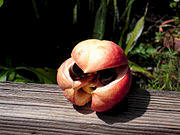 Akee
- All the parts of the akee fruit (Blighia sapida) are toxic until
fully ripened, when the thick outer shell bursts open to reveal white flesh (an
aril to botanists) surrounding three black seeds. Only the flesh loses its
toxicity when ripe; the remaining parts of the fruit remain poisonous which
caused the United States to ban their importation until recently-they can now be
found canned in Hispanic and West Indian specialty shops. Named for Captain
Bligh of mutiny fame who introduced them into the Caribbean from their home in
Africa, they form part of the unofficial national dish of Jamaica, saltfish and
akee. Akee
- All the parts of the akee fruit (Blighia sapida) are toxic until
fully ripened, when the thick outer shell bursts open to reveal white flesh (an
aril to botanists) surrounding three black seeds. Only the flesh loses its
toxicity when ripe; the remaining parts of the fruit remain poisonous which
caused the United States to ban their importation until recently-they can now be
found canned in Hispanic and West Indian specialty shops. Named for Captain
Bligh of mutiny fame who introduced them into the Caribbean from their home in
Africa, they form part of the unofficial national dish of Jamaica, saltfish and
akee.
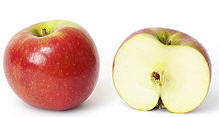 Apple
- Ever since Adam ate from the Tree of Knowledge, apples have figured in myth
and legend and, even though modern scholars now question whether the fruits in
question were actually what we know as apples, they played a role in much of
Celtic, Norse, Greek, and Roman mythology. Apple
- Ever since Adam ate from the Tree of Knowledge, apples have figured in myth
and legend and, even though modern scholars now question whether the fruits in
question were actually what we know as apples, they played a role in much of
Celtic, Norse, Greek, and Roman mythology.
Apples are the fruits of the trees of the Malus genus
and, along with pears, quinces, and medlars, they form the group known as pome
fruits, all members of the Rose family of plants. Modern apples are descended
from wild apples, or crab apples, about 30 species of which range across Asia,
Europe, and North America. They were cultivated by cross-breeding crab apples at
least 3,000 years ago and apparently originated in the portion of Central Asia
between the Caspian and Black seas.
Owing to their hybrid nature, a single apple tree will produce
widely varying offspring when grown from seed, and in order to reproduce
desirable characteristics in future generations, apple trees must be grafted.
This sophisticated horticultural procedure was known and described by the
ancient Greeks and was no doubt practiced for many centuries before.
This same variability has led to the development of over 7,000
named varieties of apples which are now grown in every temperate country on
Earth. The apple tree's resistance to temperatures as low as -40º F (-40º C)
makes it the fruit capable of growing at higher latitudes than any other
fruit-with the exception of a couple of types of berries. Its ability to prosper
in northern climates (apple trees require at least two months of nighttime
temperatures below freezing in order to flower the following spring) combined
with the durability and long shelf life of the fruit after it has been picked
made it an invaluable crop in northern Europe and Asia.
Apples come in every size from as small as a cherry to as large
as a grapefruit; in every shape from round to oval to pear-shaped and even
"cornered," or slightly boxy; in colors from green to yellow to mottled red and
dark, almost black red; and in flavor and texture ranging from crisp and sour to
soft and sweet. Some varieties have flavors reminiscent of pineapple, banana,
anise, lemon, and even fennel. The skins may be thin or thick and unpalatable,
and smooth or mottled with a coarse brown texture known as scald. In Britain and
most of the English-speaking world, apples are grouped into two categories:
eating (or dessert) apples, and cooking apples. Other cultures quite correctly
consider all apples suitable for both eating raw and cooked, although some might
be disagreeably tart in their raw state. This tartness is caused by malic acid
in the fruit, and it is this same acid that gives the sour candies that are so
popular with kids these days their mouth-puckering qualities.
Once considered the most nutritious of all fruits (which gave
rise to the saying "an apple a day keeps the doctor away"), apples are in fact
not as nutritious as many other fruits. They are a reasonably good source of
vitamins A and C, and are an excellent source of dietary fiber.
Some of the most popular cultivars include the Red Delicious
which was developed on a Quaker farm in Iowa in the 1890s, the Golden Delicious
which was developed in West Virginia around 1850 and related to the Red
Delicious in name only, and the deliciously tart Granny Smith which was
originally cultivated by Mrs. Maria Smith in Sydney, Australia around 1865. In
addition to these, only about 20 to 30 other varieties are in widespread
cultivation around the world today, and an approximately equal number of
varieties might be available locally in many regions of the globe.
Unfortunately, the realities of modern agribusiness and a global economy have
caused many of the lesser known-and more interesting-varieties to become
extinct.
 Apricot
- In spite of their Latin name Prunus armeniaca, apricots are not from
Armenia. They actually originated in central Asia where they were cultivated by
the Chinese at least 4,000 years ago, and from there spread to other parts of
the ancient world, including Persia and Armenia where the Romans first
encountered them. Many Biblical references to apples may have been referring to
apricots. The Hebrew word "tappauch" was a generic term for fruit, and early
translators of Hebrew texts into English were unfamiliar with apricots, but
apples were well known to them so "tappauch" was translated as "apple," and the
mistranslation has been passed on. Apricot
- In spite of their Latin name Prunus armeniaca, apricots are not from
Armenia. They actually originated in central Asia where they were cultivated by
the Chinese at least 4,000 years ago, and from there spread to other parts of
the ancient world, including Persia and Armenia where the Romans first
encountered them. Many Biblical references to apples may have been referring to
apricots. The Hebrew word "tappauch" was a generic term for fruit, and early
translators of Hebrew texts into English were unfamiliar with apricots, but
apples were well known to them so "tappauch" was translated as "apple," and the
mistranslation has been passed on.
Along with other species of the Prunus genus such as
peaches, plums, and cherries, apricots belong to a group of fruits known as
stone fruits. This genus also includes almonds, a close relative of the peach.
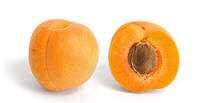
Apricots look like small, pale peaches with smooth skins and sweet but
relatively dry flesh compared to some of their cousins. They are available fresh
during their short season in June and July, but they don't travel or age well,
so the bulk of fresh apricots are dried, canned, or turned into preserves. About
20 varieties are grown commercially in the United States (the world's largest
producer, with California accounting for about 90 percent of the harvest),
China, and Europe, especially in Hungary, Spain, France, and Italy.
Apricots are high in vitamin A, calcium, iron, and beta-carotene.
The kernels are used to flavor baked goods and the popular liqueur Amaretto, but
like all the kernels of the members of the Prunus genus, they contain
high concentrations of cyanide compounds and are toxic unless cooked before
consumption.
 Arbutus
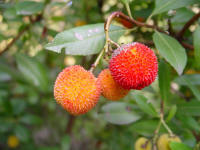
- Also known as tree strawberries, the fruits of the Arbutus unedo
shrub native to Europe resemble strawberries in appearance only. Their flavor is
mild and unexciting, tasting vaguely like vanilla. You aren't likely to find
them fresh in supermarkets, but they can be found growing wild in much of Europe
(in Ireland they're called Killarney strawberries) and are traditionally used to
make jellies and liqueurs. Arbutus
- Also known as tree strawberries, the fruits of the Arbutus unedo
shrub native to Europe resemble strawberries in appearance only. Their flavor is
mild and unexciting, tasting vaguely like vanilla. You aren't likely to find
them fresh in supermarkets, but they can be found growing wild in much of Europe
(in Ireland they're called Killarney strawberries) and are traditionally used to
make jellies and liqueurs.
 Atemoya
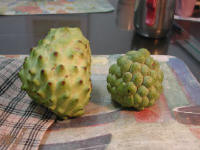
- This hybrid of two Annona species (cherimoya and sweetsop) was
"invented" by a US Department of Agriculture scientist in 1917, but the same
cross occurred naturally in Australia in 1850 and again in Israel in 1930. About
the size of a bell pepper, the atemoya has the characteristic lumpy skin of its
parents and the same soft custard-like sweet flesh studded with large black
seeds. Its flavor has been compared to a combination of mango and vanilla. It is
grown commercially in Florida, but due to the small size of the crop, fresh
atemoyas are rarely available outside the state. They are usually sold in their
unripe state as they continue to ripen after they have been picked. Best eaten
raw by scooping the flesh out of the halved fruit, they are high in vitamins C
and K. Atemoya
- This hybrid of two Annona species (cherimoya and sweetsop) was
"invented" by a US Department of Agriculture scientist in 1917, but the same
cross occurred naturally in Australia in 1850 and again in Israel in 1930. About
the size of a bell pepper, the atemoya has the characteristic lumpy skin of its
parents and the same soft custard-like sweet flesh studded with large black
seeds. Its flavor has been compared to a combination of mango and vanilla. It is
grown commercially in Florida, but due to the small size of the crop, fresh
atemoyas are rarely available outside the state. They are usually sold in their
unripe state as they continue to ripen after they have been picked. Best eaten
raw by scooping the flesh out of the halved fruit, they are high in vitamins C
and K.
 Avocado
- Although they are treated as a vegetable in North American and Europe, much of
the world treats the fruits of the Persea americana tree as the fruit
that they are; the creamy smooth flesh is routinely added to fruit salads in
Africa and Asia, and the Brazilians turn them into ice creams, custards, and
other sweet concoctions. Although there are hundreds (if not thousands) of
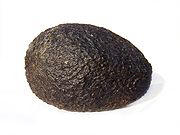
naturally occurring varieties of avocados, only two make regular appearances in
American supermarkets: the large green, smooth-skinned Fuerte, and the smaller
almost black, pebbly-skinned Haas. Avocados are one of the few fruits high in
saturated fats, yet they are relatively low in calories due to their low sugar
content, and contain fair amounts of vitamin C and thiamine. Avocado
- Although they are treated as a vegetable in North American and Europe, much of
the world treats the fruits of the Persea americana tree as the fruit
that they are; the creamy smooth flesh is routinely added to fruit salads in
Africa and Asia, and the Brazilians turn them into ice creams, custards, and
other sweet concoctions. Although there are hundreds (if not thousands) of
naturally occurring varieties of avocados, only two make regular appearances in
American supermarkets: the large green, smooth-skinned Fuerte, and the smaller
almost black, pebbly-skinned Haas. Avocados are one of the few fruits high in
saturated fats, yet they are relatively low in calories due to their low sugar
content, and contain fair amounts of vitamin C and thiamine.
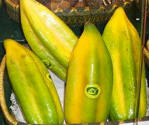 Babaco
- The fruit of the Carica pentagona tree, a natural hybrid of the
papaya, resembles a long, five-sided version of its cousin. This South American
native is not widely available outside of its natural range, even though it is
currently being grown commercially in Florida, New Zealand, and the Channel
Islands. The flavor is likened to a cross between a pineapple and a banana, but
without the sweetness of either. They are best eaten raw-skin and all-but can
also be poached in syrup and used to make savory chutneys and relishes. Babacos
(with the emphasis on the second "ba") are high in vitamins A and C and contain
three times as much of the enzyme papain as papayas. Babaco
- The fruit of the Carica pentagona tree, a natural hybrid of the
papaya, resembles a long, five-sided version of its cousin. This South American
native is not widely available outside of its natural range, even though it is
currently being grown commercially in Florida, New Zealand, and the Channel
Islands. The flavor is likened to a cross between a pineapple and a banana, but
without the sweetness of either. They are best eaten raw-skin and all-but can
also be poached in syrup and used to make savory chutneys and relishes. Babacos
(with the emphasis on the second "ba") are high in vitamins A and C and contain
three times as much of the enzyme papain as papayas.
 Banana
- It is ironic that the world's most popular fruit is descended from an
herbaceous plant whose fruit is inedible. At least forty species of the Musa
genus grow wild in Southeast Asia and the Pacific islands, and all of them have
seedy fruits of little or no practical value. Thousands of years ago one
species, Musa acuminata, underwent some genetic mutations and began
producing seedless fruits without the benefit of pollination. This was later
hybridized (maybe naturally, maybe by early agronomists) with an inedible wild
banana (M. balbisiana) and the modern banana was born. Scientists
believe that bananas may have been cultivated as long as 15,000 years ago,
making them a candidate for the first crop domesticated by humans. Banana
- It is ironic that the world's most popular fruit is descended from an
herbaceous plant whose fruit is inedible. At least forty species of the Musa
genus grow wild in Southeast Asia and the Pacific islands, and all of them have
seedy fruits of little or no practical value. Thousands of years ago one
species, Musa acuminata, underwent some genetic mutations and began
producing seedless fruits without the benefit of pollination. This was later
hybridized (maybe naturally, maybe by early agronomists) with an inedible wild
banana (M. balbisiana) and the modern banana was born. Scientists
believe that bananas may have been cultivated as long as 15,000 years ago,
making them a candidate for the first crop domesticated by humans.
Bananas grow in clusters ("hands") of about a dozen bananas
("fingers") that circle a long stalk that grows from the central core of the
plant, and many people are surprised to see these hands growing upside down,
with their curved fingers pointing towards the sky. Up to 200 bananas may grow
on a single stalk, and bananas are one of a very small group of fruits that
actually continue to mature after they are picked. This makes them ideal for
shipping great distances as they may be picked green and shipped as they mature,
arriving at their destination ready to eat up to several weeks later.
Today there are over 200 cultivars in commercial production, and
the one we are most familiar with is the Dwarf Cavendish variety developed by
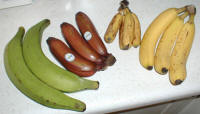
the Duke of Devonshire in 1836. Finger bananas, also called sugar bananas, are
much smaller than the Cavendish variety and are renowned for their soft, sweet
flesh. Other varieties are available sporadically in finer supermarkets and from
specialty produce vendors, including red bananas (only the skin is red, the
flesh is like other bananas), and apple bananas which have a faint flavor of
apples.
The vast majority of bananas eaten worldwide are eaten raw,
although the fruit is suitable for cooking in a variety of ways and can be
included in many savory and sweet dishes. The ideal stage of ripeness for eating
is largely a matter of personal preference; many people prefer them on the
under-ripe side, when the tips of the bananas are still tinged with green and
the flesh is still firm, while others prefer to let their bananas mature until
the skin is speckled with brown dots and the flesh has acquired a soft,
custard-like consistency. Bananas should be stored at room temperature until
they are ripe, at which time they should be eaten or refrigerated. Refrigeration
will turn the skin black, but the fruit will remain ready to eat for up to three
or four days. Bananas also freeze with excellent results, and they may be frozen
peeled and cut into manageable pieces, or whole and unpeeled. One of the more
nutritious of fruits, bananas are rich in potassium, riboflavin, niacin,
vitamins A and C, and dietary fiber.
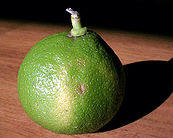 Bergamot
- These small, yellow members of the citrus family are rarely found in produce
markets, but the flavor and aroma of the fruits of the Citrus bergamia
tree are well known to tea drinkers-the essential oils from the skin provide the
distinct taste of Earl Grey tea. The oil is also used in making candies and
perfumes, and the fruits may also be made into preserves and marmalades. Bergamot
- These small, yellow members of the citrus family are rarely found in produce
markets, but the flavor and aroma of the fruits of the Citrus bergamia
tree are well known to tea drinkers-the essential oils from the skin provide the
distinct taste of Earl Grey tea. The oil is also used in making candies and
perfumes, and the fruits may also be made into preserves and marmalades.
.jpg) Berries
- Any botanist will tell you that a berry is the fruit of a plant which develops
from a single ovary and contains few or many seeds, but not a single pit. By
that definition, blueberries, cranberries, and currants all qualify as true
berries. But then so do bananas, tomatoes, and eggplants, and once again we are
faced with a lack of agreement in terminology between botanists and cooks. To
further complicate matters, some of the fruits we think of as berries, such as
strawberries, raspberries, and blackberries, are not really berries. For the
sake of simplicity and my own sanity, we are going to treat those things that
cooks know to be berries as berries, and the heck with the botanists. See
individual listing for details on each type of berry. Berries
- Any botanist will tell you that a berry is the fruit of a plant which develops
from a single ovary and contains few or many seeds, but not a single pit. By
that definition, blueberries, cranberries, and currants all qualify as true
berries. But then so do bananas, tomatoes, and eggplants, and once again we are
faced with a lack of agreement in terminology between botanists and cooks. To
further complicate matters, some of the fruits we think of as berries, such as
strawberries, raspberries, and blackberries, are not really berries. For the
sake of simplicity and my own sanity, we are going to treat those things that
cooks know to be berries as berries, and the heck with the botanists. See
individual listing for details on each type of berry.
Bilberry - See blueberry
 Blackberry
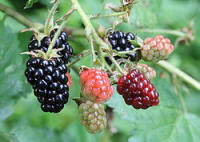
- Having recently declared that blackberries are not really berries, it's time
to explain what I was talking about. Blackberries are actually clusters of
small, individual berries (achenes to botanists) each containing its own seed.
The fruits of the Rubus fruticosus are closely related and very similar
to several other members of the Rubus genus such as raspberries,
loganberries, and cloudberries. Dewberries, another close relative, are very
similar to blackberries except that blackberries are larger and grow on upright
bushes, while dewberries are smaller and grow on trailing plants. Blackberry
- Having recently declared that blackberries are not really berries, it's time
to explain what I was talking about. Blackberries are actually clusters of
small, individual berries (achenes to botanists) each containing its own seed.
The fruits of the Rubus fruticosus are closely related and very similar
to several other members of the Rubus genus such as raspberries,
loganberries, and cloudberries. Dewberries, another close relative, are very
similar to blackberries except that blackberries are larger and grow on upright
bushes, while dewberries are smaller and grow on trailing plants.
Wild blackberries were eaten by prehistoric man, a fact
established by fossilized seeds excavated from prehistoric sites, and they can
still be found throughout the temperate northern climates of both the eastern
and western hemispheres. Like the other members of their genus, blackberries
hybridize easily with their close relatives, making the identification of the
original ancestral blackberry something that botanists are still scratching
their heads over. Their history of cultivation is equally problematic because
they are so easily collected in the wild that there was little need to cultivate
them in earlier times, and it is difficult to determine when they were first
planted and tended rather than simply gathered from the wild.
Fresh blackberries are generally available in the northern
hemisphere from May through August. They do not ripen after being picked, so be
careful to avoid blackberries with their hulls still attached as this is an
indication that they were picked too early. They spoil quickly due to their thin
skins and should be used within a day or two of their purchase. They will keep
for two or three days if stored in the refrigerator, preferably lightly covered
and in a single layer, and they may also be frozen with excellent results,
although their texture will be affected. They are best eaten fresh, but they
also make wonderful jams and preserves and are widely used in baked goods. In
England, blackberries and apples are a favorite combination for pies.
 Blueberry
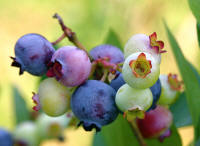
- Of all the fruits to be included in this dictionary, none proved more of a
research challenge than blueberries. I consulted more than a dozen references,
including several food and horticultural reference books, encyclopedias and
dictionaries, and no two authorities agreed on all points concerning the
distinctions between various types of blueberries. To further complicate
matters, nomenclature varies regionally and one berry might be called by several
names in one place, and several berries might be known collectively under one
name in other areas. Here is what I have been able to sort out. Blueberry
- Of all the fruits to be included in this dictionary, none proved more of a
research challenge than blueberries. I consulted more than a dozen references,
including several food and horticultural reference books, encyclopedias and
dictionaries, and no two authorities agreed on all points concerning the
distinctions between various types of blueberries. To further complicate
matters, nomenclature varies regionally and one berry might be called by several
names in one place, and several berries might be known collectively under one
name in other areas. Here is what I have been able to sort out.
Early colonists of North America discovered berries similar to
the bilberries they knew from northern Europe, where they were also known as
whortleberries. This name was also used for cranberries, and somewhere along the
line "whortleberry" became "hurtleberry." This name was further corrupted until
it became huckleberry. So, somewhere at some time, blueberries, bilberries,
cranberries, and huckleberries (four different species in two different genera)
have all been known as blueberries, bilberries, whortleberries, cranberries,
craneberries, hurtleberries, or huckleberries. Got it?
Blueberries and bilberries are both members of the Vaccinium
genus. Bilberries are native to Europe and include several species, but most
notably Vaccinium myrtillis. In England they are also known as
whinberries and blaeberries. (I told you this was complicated, didn't I?)
Blueberries are native to North America and are represented by three primary
species: high-bush (V. corymbosum), "rabbit-eye" (V. ashei),
and low-bush (V. angustifolium).
Although blueberries are slightly larger and sweeter than
bilberries, they are very similar to each other in appearance and taste and may
be indistinguishable to the layman. North American production of blueberries is
extensive and great quantities are exported to Europe. Thus, a European consumer
may be buying North American blueberries when she thinks she is buying European
bilberries (or whortleberries, or blaeberries, or whatever), further adding to
the confusion.
Regardless of what you call them, blueberries and bilberries are
small, round, and dark blue to almost black in color with a silvery frost. They
have thin skins, soft flesh, tiny soft seeds, and a unique flavor. They are best
when in season from May to early October, and fresh blueberries from New Zealand
are available through most of the rest of the year in the United States. They
are also available dried, frozen, and canned.
Native Americans used blueberries extensively in soups and stews,
and they were one of the primary components of pemmican, the American Indian
version of energy bars. Today they are used in every type of baked good,
including muffins, cookies, cakes, cobblers, and pies, and they make excellent
jams, jellies, and preserves. Rich in vitamin C, iron, and dietary fiber, they
are also high in anti-oxidants whose health benefits are theorized but have yet
to be proven.
 Bullace
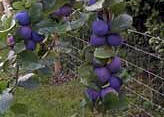
- The fruits of the Prunus institia shrub native to Europe come in two
varieties: "black" bullaces which are bluish purple in color; and "white"
bullaces which are actually a pale greenish yellow. These wild plums are so tart
in flavor that they are virtually inedible raw, but they are often sweetened and
used in pies and pastry fillings, as well as jams and preserves. Bullace
- The fruits of the Prunus institia shrub native to Europe come in two
varieties: "black" bullaces which are bluish purple in color; and "white"
bullaces which are actually a pale greenish yellow. These wild plums are so tart
in flavor that they are virtually inedible raw, but they are often sweetened and
used in pies and pastry fillings, as well as jams and preserves.
 Calamansi
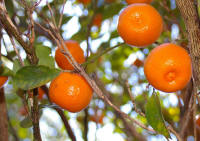
- This small citrus fruit (Citrus madurensis) native to the Philippines
resembles a tangerine and its tart juice is used in marinates and sauces. It is
rarely, if ever, available outside Southeast Asia. Calamansi
- This small citrus fruit (Citrus madurensis) native to the Philippines
resembles a tangerine and its tart juice is used in marinates and sauces. It is
rarely, if ever, available outside Southeast Asia.
Calamondin - See calamansi
Cantaloupe - See muskmelon
 Cape
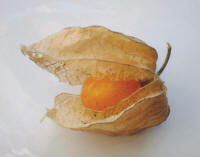
Gooseberry - Also known as ground cherries and physalis, the Physalis
peruviana is native to South America, and it is something of a botanical
mystery how these cherry-sized orange berries came to be known to the ancient
Greeks. Close relative to other South American natives like tomatoes and
peppers, the fruits are encased in a beige papery husk similar to their cousin
tomatillos. They have a delightful, distinctive taste and are excellent eaten
raw or cooked in baked goods and preserves. Cape
Gooseberry - Also known as ground cherries and physalis, the Physalis
peruviana is native to South America, and it is something of a botanical
mystery how these cherry-sized orange berries came to be known to the ancient
Greeks. Close relative to other South American natives like tomatoes and
peppers, the fruits are encased in a beige papery husk similar to their cousin
tomatillos. They have a delightful, distinctive taste and are excellent eaten
raw or cooked in baked goods and preserves.
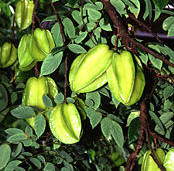 Carambola
- Better known as star fruits, the fruits of the Southeast Asian Averrhoea
corombola have become widely available in US supermarkets. They are three
to five inches (7.5-12.5 cm) long with five ridges running their length, giving
them a star-shaped cross section. They are often sold slightly green along the
ridges and are ripe when completely yellow. Their mild flavor ranges from sweet
to tart, depending on variety, and with edible skin and seeds, they are good for
eating out of hand. They are generally eaten raw but can also be poached in
syrup or made into jams, and are high in vitamin C with moderate amounts of
niacin, potassium, and phosphorus. Carambola
- Better known as star fruits, the fruits of the Southeast Asian Averrhoea
corombola have become widely available in US supermarkets. They are three
to five inches (7.5-12.5 cm) long with five ridges running their length, giving
them a star-shaped cross section. They are often sold slightly green along the
ridges and are ripe when completely yellow. Their mild flavor ranges from sweet
to tart, depending on variety, and with edible skin and seeds, they are good for
eating out of hand. They are generally eaten raw but can also be poached in
syrup or made into jams, and are high in vitamin C with moderate amounts of
niacin, potassium, and phosphorus.
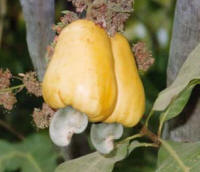 Cashew
Apple - The fruit of the Anacardium occidentale tree native to Central
and South America is actually the kidney-shaped cashew nut. The nut grows at the
bottom of the custard apple, a pear-shaped "fruit" which is actually the stalk
of the true fruit. It has a yellow-orange skin and tart, soft flesh and although
it may be eaten raw out of hand, it is most often used to make wine, liqueurs,
and vinegar. Cashew apples are not imported into the United States. Cashew
Apple - The fruit of the Anacardium occidentale tree native to Central
and South America is actually the kidney-shaped cashew nut. The nut grows at the
bottom of the custard apple, a pear-shaped "fruit" which is actually the stalk
of the true fruit. It has a yellow-orange skin and tart, soft flesh and although
it may be eaten raw out of hand, it is most often used to make wine, liqueurs,
and vinegar. Cashew apples are not imported into the United States.
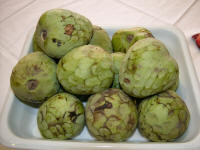 Cherimoya
- Also called custard apples, cherimoyas are large fruits with green skin that
looks like a collection of overlapping thumbprint indentations. The skin turns
dark brown when the fruit is ripe. The flesh is creamy white with a smooth,
custard-like texture dotted with large, black, inedible seeds. Although the
Annona cherimola tree is native to the tropics of Central and South
America, cherimoyas are now grown commercially in Florida and California. Choose
fruits with unblemished skins that are free from cracks where the skins segments
(called corpels) have separated. Store at room temperature in a paper bag until
ripe. Once ripe, they will keep for up to four days in the refrigerator. They
may be used to make beverages and sauces, but the best way to eat a cherimoya is
to cut the fruit in half and scoop out the sweet flesh, whose flavor has been
compared to a combination of pineapple, banana, and strawberry. Cherimoya
- Also called custard apples, cherimoyas are large fruits with green skin that
looks like a collection of overlapping thumbprint indentations. The skin turns
dark brown when the fruit is ripe. The flesh is creamy white with a smooth,
custard-like texture dotted with large, black, inedible seeds. Although the
Annona cherimola tree is native to the tropics of Central and South
America, cherimoyas are now grown commercially in Florida and California. Choose
fruits with unblemished skins that are free from cracks where the skins segments
(called corpels) have separated. Store at room temperature in a paper bag until
ripe. Once ripe, they will keep for up to four days in the refrigerator. They
may be used to make beverages and sauces, but the best way to eat a cherimoya is
to cut the fruit in half and scoop out the sweet flesh, whose flavor has been
compared to a combination of pineapple, banana, and strawberry.
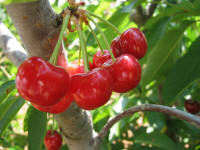 Cherry
- These members of the Prunus genus of the rose family, along with
their cousins apricots, peaches, and plums, form the group of fruits known to
agronomists and cooks as stone fruits. Native to the mountainous areas of Asia
Minor, all stone fruits still display their preference for temperate climates by
their need for freezing winter temperatures and a refusal to flourish in balmy
tropical climates. Cherries have been cultivated in China for at least 5,000
years, and archeological evidence indicates that ancient people collected the
wild fruits over 10,000 years ago. Cherry
- These members of the Prunus genus of the rose family, along with
their cousins apricots, peaches, and plums, form the group of fruits known to
agronomists and cooks as stone fruits. Native to the mountainous areas of Asia
Minor, all stone fruits still display their preference for temperate climates by
their need for freezing winter temperatures and a refusal to flourish in balmy
tropical climates. Cherries have been cultivated in China for at least 5,000
years, and archeological evidence indicates that ancient people collected the
wild fruits over 10,000 years ago.
Cherries are divided into two main groups: sweet and sour. Sweet
cherries are also similarly divided into two main groups: bigarreaus and geans
(or guines). The best known of the bigarreau type are the pale yellow Napoleon
and the deep red Bing varieties. Gean cherries, whose flesh is
characteristically softer and juicier than the bigarreau varieties, include the
deep purple Black Tartarian and the golden-skinned Ranier varieties. Most fresh
cherries found in supermarkets are sweet cherries as they are preferred for
eating raw and out of hand.
Sour cherries are better suited to cooking and for flavoring
liqueurs. Also divided into two main groups, morellos have dark juice and
amarelles have a clear, almost colorless juice. The flavor of sour cherries
ranges from almost sweet to bitter and tart, and some varieties are so tart that
they are considered inedible in the raw state. Montmorency are among the
sweetest and best known sour cherries and have given their name to a range of
dishes-"a la Montmorency" means "with cherries" in classic French cuisine.
Maraschino cherries are a type of wild cherry that were distilled
into a colorless, sweet liqueur called Maraschino. The cherries themselves were
preserved in Maraschino liqueur and marketed as "Maraschino cherries," but
nowadays any type of cherry can be used (the Royal Ann is the most often used)
and the Maraschino liqueur has been replaced by an artificially colored syrup
with almond flavoring. The genuine Maraschino cherries are still available in
specialty shops-be sure to read the label carefully.
As a general rule, pale cherries tend to be sweeter than the
darker cherries, which tend to be more acidic. Always buy fresh cherries with
their stems attached-a sign of freshness-and taste them before you buy them if
possible. Store them in the refrigerator for up to a week, and wash them
immediately before eating.
Chinese Date - See jujube
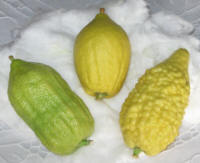 Citron
- The fruits of the Citrus medica tree resemble oversized, lumpy,
greenish-yellow lemons. The pulp is dry and extremely bitter and considered
inedible, but the thick skin of the fruit is pressed to extract citron oil used
in liqueurs and cosmetics, and candied to be used in baked goods. The peel can
also be used top make jams and marmalade. Candied citron is available in
specialty shops and finer supermarkets, and should be refrigerated or frozen to
preserve its freshness. Citron
- The fruits of the Citrus medica tree resemble oversized, lumpy,
greenish-yellow lemons. The pulp is dry and extremely bitter and considered
inedible, but the thick skin of the fruit is pressed to extract citron oil used
in liqueurs and cosmetics, and candied to be used in baked goods. The peel can
also be used top make jams and marmalade. Candied citron is available in
specialty shops and finer supermarkets, and should be refrigerated or frozen to
preserve its freshness.
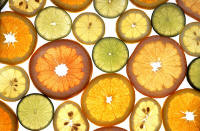 Citrus
Fruits - This large group of edible fruits of the genus Citrus includes oranges,
lemons, limes, citrons, tangerines, grapefruits, tangelos, ugli fruits, and
more. The genus, native to Asia, is a genealogist's nightmare because the
different species interbreed so readily that it is uncertain whether some
species originated as unique species or as the result of opportunistic
cross-breeding in nature. (Let's just say that if you were a fruit, you wouldn't
want to bring a Citrus home to meet your parents.) They all prefer tropical
climates and are grown in tropical and subtropical zones around the world,
making possible the year-round availability of fresh citrus almost everywhere.
They are all characteristically tart owing to the citric acid that bears their
name. See individual listing for details on each type of citrus fruit. Citrus
Fruits - This large group of edible fruits of the genus Citrus includes oranges,
lemons, limes, citrons, tangerines, grapefruits, tangelos, ugli fruits, and
more. The genus, native to Asia, is a genealogist's nightmare because the
different species interbreed so readily that it is uncertain whether some
species originated as unique species or as the result of opportunistic
cross-breeding in nature. (Let's just say that if you were a fruit, you wouldn't
want to bring a Citrus home to meet your parents.) They all prefer tropical
climates and are grown in tropical and subtropical zones around the world,
making possible the year-round availability of fresh citrus almost everywhere.
They are all characteristically tart owing to the citric acid that bears their
name. See individual listing for details on each type of citrus fruit.
Clementine - See tangerine
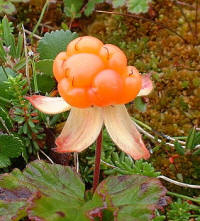 Cloudberry
- These natives of Canada, New England, and Scandinavia are close relatives of
raspberries, which they resemble except for their golden yellow color. The
fruits of Rubus chamaemorous are too tart to be eaten out of hand, but
they are used to make jams and jellies. A wild berry that is not grown
commercially, cloudberries are rarely seen in supermarkets even in their native
range. They are also known as bake-apple berries, mountain berries, and yellow
berries. Cloudberry
- These natives of Canada, New England, and Scandinavia are close relatives of
raspberries, which they resemble except for their golden yellow color. The
fruits of Rubus chamaemorous are too tart to be eaten out of hand, but
they are used to make jams and jellies. A wild berry that is not grown
commercially, cloudberries are rarely seen in supermarkets even in their native
range. They are also known as bake-apple berries, mountain berries, and yellow
berries.
Crab Apple - See apple
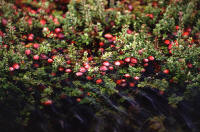 Cranberry
- Cranberries, native to northern Europe and North America, are the fruits of
several members of the Viburnum genus and are closely related to
blueberries. The name is believed to be a contraction of "craneberries" (as they
are still known in some parts of the world), supposedly for their appeal to the
large birds. They grow on long trailing vines and are harvested by flooding the
bogs they grow in and skimming the berries off the water as they bob to the
surface. They are also called "bounceberries" because ripe berries will bounce
when dropped. They are prized for their tart flavor and, in addition to the
familiar cranberry relishes that accompany holiday turkeys, they also make
wonderful pies, chutneys, preserves, cobblers, and other desserts. Because of
their thick, waxy skins, fresh cranberries have a much longer shelf life than
most other berries. They are available dried and frozen year round, and fresh
from October through December. To store fresh cranberries, remove any crushed
berries and refrigerate in an airtight container for up to 1 month, or freeze
them for up to a year. Cranberry
- Cranberries, native to northern Europe and North America, are the fruits of
several members of the Viburnum genus and are closely related to
blueberries. The name is believed to be a contraction of "craneberries" (as they
are still known in some parts of the world), supposedly for their appeal to the
large birds. They grow on long trailing vines and are harvested by flooding the
bogs they grow in and skimming the berries off the water as they bob to the
surface. They are also called "bounceberries" because ripe berries will bounce
when dropped. They are prized for their tart flavor and, in addition to the
familiar cranberry relishes that accompany holiday turkeys, they also make
wonderful pies, chutneys, preserves, cobblers, and other desserts. Because of
their thick, waxy skins, fresh cranberries have a much longer shelf life than
most other berries. They are available dried and frozen year round, and fresh
from October through December. To store fresh cranberries, remove any crushed
berries and refrigerate in an airtight container for up to 1 month, or freeze
them for up to a year.
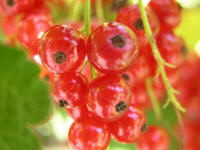 Currant
- Although dried Zante grapes are sold as dried currants, they are only
distantly related to the currants of the Ribes genus used to make
syrups, liqueurs, jams, and jellies. They are small, round, gem-like berries
that grow in clusters similar in appearance to small bunches of grapes. These
Northern European natives are closely related to gooseberries and are classed in
three categories: black, red, and white. Black currants are very tart and are
usually used for syrups and preserves, and to lend their distinctive flavor and
color to crème de cassis. Red currants are sweeter and may be eaten out of hand,
and are the basis for Cumberland sauce. White currants are also sweet enough to
be eaten alone, and they are used to make the famous Bar-le-Duc preserves of the
Lorraine region of France. If you are lucky enough to have fresh currants
available in your area during their season (June through August), treat them
like most other berries: store them unwashed in airtight containers in the
refrigerator for up to five days, and wash them just before you use them. Currant
- Although dried Zante grapes are sold as dried currants, they are only
distantly related to the currants of the Ribes genus used to make
syrups, liqueurs, jams, and jellies. They are small, round, gem-like berries
that grow in clusters similar in appearance to small bunches of grapes. These
Northern European natives are closely related to gooseberries and are classed in
three categories: black, red, and white. Black currants are very tart and are
usually used for syrups and preserves, and to lend their distinctive flavor and
color to crème de cassis. Red currants are sweeter and may be eaten out of hand,
and are the basis for Cumberland sauce. White currants are also sweet enough to
be eaten alone, and they are used to make the famous Bar-le-Duc preserves of the
Lorraine region of France. If you are lucky enough to have fresh currants
available in your area during their season (June through August), treat them
like most other berries: store them unwashed in airtight containers in the
refrigerator for up to five days, and wash them just before you use them.
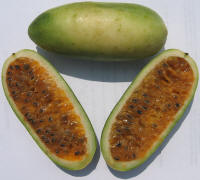 Curuba
- Also called "banana passion fruits," the elongated yellow fruits of the
Passiflora molissima are filled with large seeds surrounded by a soft,
gelatinous coating similar to passion fruits, their close relative. They are
native to South America and, although they occasionally reach American
supermarkets, the international trade in these fruits is limited. The soft skin
can be peeled like a banana, and the seeds scooped out to be eaten fresh or to
be strained to form a sweet coulis. Curuba
- Also called "banana passion fruits," the elongated yellow fruits of the
Passiflora molissima are filled with large seeds surrounded by a soft,
gelatinous coating similar to passion fruits, their close relative. They are
native to South America and, although they occasionally reach American
supermarkets, the international trade in these fruits is limited. The soft skin
can be peeled like a banana, and the seeds scooped out to be eaten fresh or to
be strained to form a sweet coulis.
Custard Apple - See cherimoya
Damson - See plum
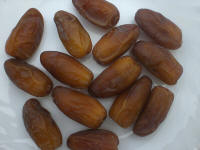 Date
- The fruits of the date palm (Phoenix dactylifera) have been
cultivated for at least 8,000 years, making it a candidate for the "first plant
cultivated by humans" prize. Native to northern Africa and the Mediterranean,
they have been spread worldwide by humans because of their value as a food crop.
Long regarded as the "tree of life," every part of the plant is used; the fruit
is eaten, the sap is drunk, the fibers are woven, and the pits are used for
animal fodder. Dates have a higher concentration of natural sugar than any other
fruit, and a single tree produces and average of more than 100 pounds (45 Kg) of
fruit per year. Date
- The fruits of the date palm (Phoenix dactylifera) have been
cultivated for at least 8,000 years, making it a candidate for the "first plant
cultivated by humans" prize. Native to northern Africa and the Mediterranean,
they have been spread worldwide by humans because of their value as a food crop.
Long regarded as the "tree of life," every part of the plant is used; the fruit
is eaten, the sap is drunk, the fibers are woven, and the pits are used for
animal fodder. Dates have a higher concentration of natural sugar than any other
fruit, and a single tree produces and average of more than 100 pounds (45 Kg) of
fruit per year.
Fresh dates are available in the regions where they are grown
(and to a lesser degree elsewhere), but dried dates are the form of the fruit
most familiar to most people. Hundreds of varieties exist, but few are exported.
Deglet noor dates from Israel and North Africa are often available, and medjool
dates are the most prized for their flavor and sweetness and are widely
available. Dates are oblong in shape (some are almost round), have a thin papery
green skin that changes to yellow, golden, brown, mahogany, or almost black
(depending on the variety) as the fruit matures, and a single long, narrow seed.
Fresh dates can be eaten as is, or the skin may be slipped off by
pinching the skin at the stem end and squeezing to extract the fruit. Both fresh
and dried dates are used in many savory dishes, especially in the Middle East
and North Africa. They make nutritious additions to salads and have a particular
affinity for cheese, but the majority of dried dates are used in baked goods and
other sweet preparations.
Dewberry - See blackberry
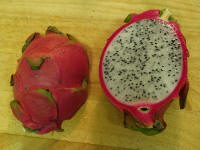 Dragon
Fruit - Also known as pitahaya, pitaya, and strawberry pear, the fruits of the
cactus Hylocereus undatus are among the most spectacular in nature.
There are two varieties that occasionally appear in markets outside of their
native range in Central and South America: the pink variety has a bright
Fuchsia-pink skin with green-tipped protrusions, and the yellow variety which
has yellow skin and resembles a small prickly pear or pineapple. Both have
translucent white flesh dotted with tiny edible black seeds and the texture of
kiwi fruit with a bland, mildly acidic flavor. They are almost always eaten raw
and the flesh can be scooped out of the halved fruit like an avocado. Dragon
Fruit - Also known as pitahaya, pitaya, and strawberry pear, the fruits of the
cactus Hylocereus undatus are among the most spectacular in nature.
There are two varieties that occasionally appear in markets outside of their
native range in Central and South America: the pink variety has a bright
Fuchsia-pink skin with green-tipped protrusions, and the yellow variety which
has yellow skin and resembles a small prickly pear or pineapple. Both have
translucent white flesh dotted with tiny edible black seeds and the texture of
kiwi fruit with a bland, mildly acidic flavor. They are almost always eaten raw
and the flesh can be scooped out of the halved fruit like an avocado.
Drupe - See stone fruit
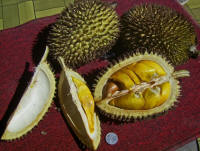 Durian
- The bad boy of the fruit world, the fruits of the Durio zibethenus
tree resemble spiny, armored footballs weighing up to 10 pounds (4.5 Kg). The
flesh of the durian surrounds large inedible seeds inside the spiked exterior.
It has such a strong and foul odor that it is banned in many restaurants, and
most airlines refuse to carry them for this reason. The soft, custard-like flesh
is valued (or craved, in the case of serious durian aficionados) for its creamy
sweetness and a flavor that some say resembles strawberries. Fresh durians are
rarely available outside their natural range in Southeast Asia, but if you do
find one it is best to eat it immediately because any attempt to store it will
make your house smell like a backed-up sewer. Canned and dried durian is
available in Asian specialty markets, but these bear little resemblance to the
fresh product. Durian
- The bad boy of the fruit world, the fruits of the Durio zibethenus
tree resemble spiny, armored footballs weighing up to 10 pounds (4.5 Kg). The
flesh of the durian surrounds large inedible seeds inside the spiked exterior.
It has such a strong and foul odor that it is banned in many restaurants, and
most airlines refuse to carry them for this reason. The soft, custard-like flesh
is valued (or craved, in the case of serious durian aficionados) for its creamy
sweetness and a flavor that some say resembles strawberries. Fresh durians are
rarely available outside their natural range in Southeast Asia, but if you do
find one it is best to eat it immediately because any attempt to store it will
make your house smell like a backed-up sewer. Canned and dried durian is
available in Asian specialty markets, but these bear little resemblance to the
fresh product.
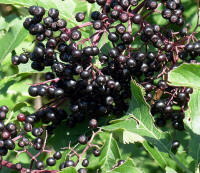 Elderberry
- The berries of the elder tree (Sambucus canadensis) contain poisonous
alkaloids and must be cooked before eating. Seldom available in stores, they
grow wild throughout the northern hemisphere and are gathered when they ripen in
the summer. They are considered too tart to be used alone and are frequently
combined with other fruits to make jams, jellies, pies, tarts, and fools. The
berries and flowers of the plant are used to make elderberry wine, and the
flowers are used to flavor drinks and to make fritters. The juice from the
berries is also used as a textile dye. Elderberry
- The berries of the elder tree (Sambucus canadensis) contain poisonous
alkaloids and must be cooked before eating. Seldom available in stores, they
grow wild throughout the northern hemisphere and are gathered when they ripen in
the summer. They are considered too tart to be used alone and are frequently
combined with other fruits to make jams, jellies, pies, tarts, and fools. The
berries and flowers of the plant are used to make elderberry wine, and the
flowers are used to flavor drinks and to make fritters. The juice from the
berries is also used as a textile dye.
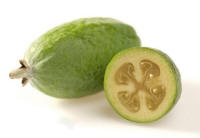 Feijoa
- Native to South America, the fruits of shrubs of the Psidium genus
are now commercially grown in New Zealand and California. The 3-inch (8 cm) long
egg-shaped fruits have a thin green skin surrounding creamy white flesh and a
soft, jelly-like center containing numerous small, edible seeds. The entire
fruit is edible including the bitter skin, which most people prefer to remove.
It has a mild, sweet flavor often compared to pineapple and strawberries, and
makes a wonderful addition to fruit salads. Also called pineapple guava although
it is only a distant relative of true guavas. Feijoa
- Native to South America, the fruits of shrubs of the Psidium genus
are now commercially grown in New Zealand and California. The 3-inch (8 cm) long
egg-shaped fruits have a thin green skin surrounding creamy white flesh and a
soft, jelly-like center containing numerous small, edible seeds. The entire
fruit is edible including the bitter skin, which most people prefer to remove.
It has a mild, sweet flavor often compared to pineapple and strawberries, and
makes a wonderful addition to fruit salads. Also called pineapple guava although
it is only a distant relative of true guavas.
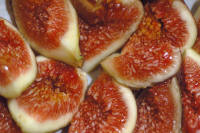 Fig
- Along with bananas and dates, figs are candidates for the distinction of being
the first fruit cultivated by man. They were said to have grown in the Garden of
Eden, and were known to even the earliest Middle Eastern civilizations. It is no
wonder their value was appreciated early on: they grow easily in poor soils with
little or no tending; they produce sugar-rich fruit (they're the sweetest of all
fruits); and the fruit dries readily for storage and transportation. The only
Mediterranean member of the huge Ficus genus (which includes the rubber
tree (F. elastica), banyan tree (various Ficus species) and
the sacred fig, or peepul (F. religiosa)), the Ficus carica
has spread nearly as widely as the humans who have carried it with them in their
migrations around the world, and is now grown in every temperate climate on the
planet. Fig
- Along with bananas and dates, figs are candidates for the distinction of being
the first fruit cultivated by man. They were said to have grown in the Garden of
Eden, and were known to even the earliest Middle Eastern civilizations. It is no
wonder their value was appreciated early on: they grow easily in poor soils with
little or no tending; they produce sugar-rich fruit (they're the sweetest of all
fruits); and the fruit dries readily for storage and transportation. The only
Mediterranean member of the huge Ficus genus (which includes the rubber
tree (F. elastica), banyan tree (various Ficus species) and
the sacred fig, or peepul (F. religiosa)), the Ficus carica
has spread nearly as widely as the humans who have carried it with them in their
migrations around the world, and is now grown in every temperate climate on the
planet.
The so-called fruits of the genus are a botanical oddity because
what we call a fruit is actually a flower head turned inside-out. The interior
of the fig contains thousands of tiny flowers that never see the light of day
and are pollinated by tiny wasps that enter the central chamber of the fig to
lay their eggs. Wild plants are either male (caprifigs) or female (true, or
edible figs), and unpolinated fruits fail to mature and fall from the tree. This
is also true for many cultivated varieties (although some will produce fruits
without pollination), so growers must include caprifigs among their orchards of
true figs in order to produce a harvest.
Fresh figs are fragile and don't travel well, so they're not
often available in supermarkets. Although there are several named varieties on
the market (usually identified by the color of their skin: green, black, and
red), there is very little difference in flavor among types of figs-their
delicate flavor is best described as just plain sweet. Buy the figs that look
and smell freshest and ignore the color of the skin and the name of the variety
when making your selection. Dried figs are widely available-try to buy ones that
are still plump rather than those that have been dried to the point of
mummification.
The entire fig is edible, although some people prefer to eat the
sweet moist interior and leave the fleshy outer skin behind. Fresh figs are
delicious eaten raw out of hand or paired with cheeses, and can be grilled or
cooked in gratins. Dried, they can also be eaten as-is or added to stews and
casseroles, and they play a major role in the cooking of the Middle East. They
are also the base for many sweet confections including baked goods, jams and
preserves, and candies.
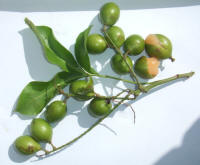 Genip
- Pronounced heh-NEEP, the cherry-sized fruits of the Melicoccus bijugatis
tree have a thick, dimpled green skin surrounding a pink or yellowish jelly-like
flesh and one or two seeds. They grow in pendulous clusters and have a flavor
similar to lychees. They are also known as mamoncilla, Spanish lime, and
limoncillo (Spanish for "little lemon"), even though they are not related to the
citrus fruits. Genip
- Pronounced heh-NEEP, the cherry-sized fruits of the Melicoccus bijugatis
tree have a thick, dimpled green skin surrounding a pink or yellowish jelly-like
flesh and one or two seeds. They grow in pendulous clusters and have a flavor
similar to lychees. They are also known as mamoncilla, Spanish lime, and
limoncillo (Spanish for "little lemon"), even though they are not related to the
citrus fruits.
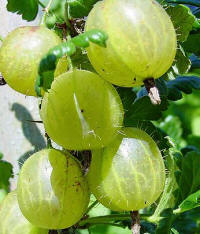 Gooseberry
- The tart berries of a shrubby, deciduous plant (Ribes grossularia)
come in a variety of colors, ranging from almost white through green and yellow
to deep red. These natives to northern Europe, like their close cousins currants
and many other members of the Ribes genus, are considered too tart to
be eaten out of hand, but are highly prized for use in pies, preserves, and
trifles. Cultivated only since the 16th century, they grow wild in profusion in
the woods of northern Europe, and were introduced into England where they
escaped from gardens and naturalized. The origin of the name is something of a
mystery; the most popular theory suggests they were used to make a sauce for
goose. The French name is similarly associated with a rich, fatty food- they are
known as groseille a maquereau, or "red currants for mackerel." Gooseberry
- The tart berries of a shrubby, deciduous plant (Ribes grossularia)
come in a variety of colors, ranging from almost white through green and yellow
to deep red. These natives to northern Europe, like their close cousins currants
and many other members of the Ribes genus, are considered too tart to
be eaten out of hand, but are highly prized for use in pies, preserves, and
trifles. Cultivated only since the 16th century, they grow wild in profusion in
the woods of northern Europe, and were introduced into England where they
escaped from gardens and naturalized. The origin of the name is something of a
mystery; the most popular theory suggests they were used to make a sauce for
goose. The French name is similarly associated with a rich, fatty food- they are
known as groseille a maquereau, or "red currants for mackerel."
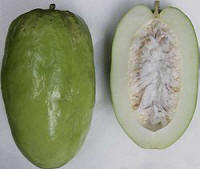 Granadilla
- The largest members of the passion fruit family, the smooth, orange fruits of
the Passiflora quadrangularis can weigh several pounds. Like their
cousins, the interior of the fruit contains several small, black seeds
surrounded by a grayish, sweet, subtly-flavored pulp. Granadilla
- The largest members of the passion fruit family, the smooth, orange fruits of
the Passiflora quadrangularis can weigh several pounds. Like their
cousins, the interior of the fruit contains several small, black seeds
surrounded by a grayish, sweet, subtly-flavored pulp.
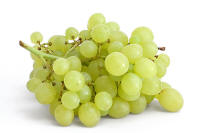 Grape
- Members of the Vitis genus are native to every continent except
Antarctica, and there are countless varieties of grapes in cultivation. Many are
used exclusively for making wine, and while this may have been the original
motivation behind their early cultivation, wine grapes are not the focus of this
article. Here we will focus on two other categories of grapes: table grapes, and
those that are grown for commercial food production. Grape
- Members of the Vitis genus are native to every continent except
Antarctica, and there are countless varieties of grapes in cultivation. Many are
used exclusively for making wine, and while this may have been the original
motivation behind their early cultivation, wine grapes are not the focus of this
article. Here we will focus on two other categories of grapes: table grapes, and
those that are grown for commercial food production.
Table groups can be divided into two binary categories: black and
white (or red and green, depending on where you are from); and seeded and
seedless. By far the most popular table grape in the United States is the white
Thompson Seedless, but other varieties of white seedless grapes are also
available, including Perlette and Sultana (from which both Perlette and Thompson
Seedless are derived). Black or red seedless grapes are also widely available,
with Flame being one of the more ubiquitous seedless varieties in American
supermarkets, and dark (almost black) Ribier being a commonly found seeded
variety. Many other varieties of table grapes are available for short periods
during their short season, so be sure to give each a try as they become
available in your area because every table grape has a unique set of qualities.
Grapes whose primary purpose is for processing into raisins or
preserves include the small seedless Zante grape of Greece and Turkey that is
dried to make currants; Muscat grapes whose drying results in the bulk of the
dark raisins we buy; and the North American Concord grape that is used to make
juice and jellies. Golden raisins (sultanas) are usually made from Thompson
Seedless grapes, even though these can also be turned into dark raisins by
employing a different drying process.
Grapes are an indispensable ingredient in fruit and gelatin
salads, and can also be added to green salads. They can also be cooked with
chicken, fish, and veal, and the French term Veronique is used to describe
dishes garnished with seedless white grapes. Their juice is used in cooking (not
just in the form of wine), and verjuice, the sour juice of unripe grapes, is
used in the manner of lemon juice and vinegar in parts of the Mediterranean.
Buy grapes with a greyish, powdery coating (called the "bloom")
on them-the lack of this bloom indicates that they have been scrubbed and
possibly adulterated in other ways on their way to market. Store unwashed grapes
in a plastic bag in the refrigerator where they will remain fresh for up to two
weeks. Wash them immediately before eating, and allow them to come to room
temperature for best flavor.
.jpg) Grapefruit
- Grapefruits are typical of the citrus family in that they are the product of a
cross between two species of this rather promiscuous genus. My sources don't all
agree on the actual parentage of this large, round fruit that grows in clusters
(hence the grape-like appellation), but it appears to be a cross between a
pomelo and some other citrus-perhaps the orange-that was developed in the 18th
century. The juicy flesh ranges in color from light yellow (almost white) to
deep red, and many connoisseurs believe that the pinker the flesh, the sweeter
the fruit. They are almost always eaten fresh and raw, usually heavily sweetened
to counteract their assertive tartness. They are also welcome additions to green
salads, and they make wonderful marmalade. Grapefruit
- Grapefruits are typical of the citrus family in that they are the product of a
cross between two species of this rather promiscuous genus. My sources don't all
agree on the actual parentage of this large, round fruit that grows in clusters
(hence the grape-like appellation), but it appears to be a cross between a
pomelo and some other citrus-perhaps the orange-that was developed in the 18th
century. The juicy flesh ranges in color from light yellow (almost white) to
deep red, and many connoisseurs believe that the pinker the flesh, the sweeter
the fruit. They are almost always eaten fresh and raw, usually heavily sweetened
to counteract their assertive tartness. They are also welcome additions to green
salads, and they make wonderful marmalade.
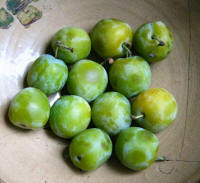 Greengage
- The small, round plum-like fruits of the Prunus italica tree have
skins ranging from green to yellow and a tart, sweet flavor. They are closely
related to plums, and many green varieties of plums are often mistakenly
identified as greengages. True greengages are rarely available in American
markets, but they are very popular in Europe where they are often used to make
compotes and jams, but they are especially prized for their delicate sweetness
and are usually eaten raw. In France they are called Reine-Claude for
the wife of Francois I who was reportedly especially fond of them. Greengage
- The small, round plum-like fruits of the Prunus italica tree have
skins ranging from green to yellow and a tart, sweet flavor. They are closely
related to plums, and many green varieties of plums are often mistakenly
identified as greengages. True greengages are rarely available in American
markets, but they are very popular in Europe where they are often used to make
compotes and jams, but they are especially prized for their delicate sweetness
and are usually eaten raw. In France they are called Reine-Claude for
the wife of Francois I who was reportedly especially fond of them.
Ground Cherry - See cape gooseberry
Guanabana - See soursop
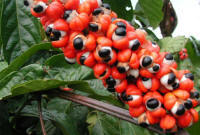 Guarana
- The berries of the Paullinia cupana tree native to northern Brazil
and Venezuela have a unique, berry-like flavor that makes them popular as a
flavoring for soft drinks and candies in Brazil. Guarana (gwah-rah-NAH) is only
available in the United States as a soft drink (distributed by one of the big
soft drink companies and becoming increasingly available nationwide as its
popularity grows), and in the form of various cure-all and weight-loss "health"
supplements that currently have a small following of fad-following proponents.
Consumers should be aware that "guaranine" is often listed among the "active"
ingredients in products containing guarana. This is just another name for
caffeine, which may account for the various unfounded claims of medicinal
properties. Guarana
- The berries of the Paullinia cupana tree native to northern Brazil
and Venezuela have a unique, berry-like flavor that makes them popular as a
flavoring for soft drinks and candies in Brazil. Guarana (gwah-rah-NAH) is only
available in the United States as a soft drink (distributed by one of the big
soft drink companies and becoming increasingly available nationwide as its
popularity grows), and in the form of various cure-all and weight-loss "health"
supplements that currently have a small following of fad-following proponents.
Consumers should be aware that "guaranine" is often listed among the "active"
ingredients in products containing guarana. This is just another name for
caffeine, which may account for the various unfounded claims of medicinal
properties.
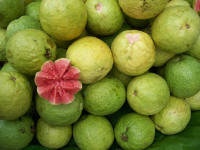 Guava
- Guavas range in size from a large olive to medium apples; in color from green
and yellow to deep red on the exterior; and from creamy white to vivid pink on
the interior. Most of the guavas that reach markets are from the shrub-like
Psidium guajave tree, but several other varieties are often available in
their native range in South America. The soft fleshy interior containing many
edible seeds is fragrant and sweet, with an aroma and flavor that is often
compared to quinces. Guavas are excellent for out-of-hand eating, and they are
widely available poached in syrup, canned, in jellies and jams, and in the form
of a thick paste called guayabada in Spanish. Guavas continue to ripen
after they are picked, so allow under-ripe fruits to ripen at room temperature,
and then store them in the refrigerator for up to four days. Guava
- Guavas range in size from a large olive to medium apples; in color from green
and yellow to deep red on the exterior; and from creamy white to vivid pink on
the interior. Most of the guavas that reach markets are from the shrub-like
Psidium guajave tree, but several other varieties are often available in
their native range in South America. The soft fleshy interior containing many
edible seeds is fragrant and sweet, with an aroma and flavor that is often
compared to quinces. Guavas are excellent for out-of-hand eating, and they are
widely available poached in syrup, canned, in jellies and jams, and in the form
of a thick paste called guayabada in Spanish. Guavas continue to ripen
after they are picked, so allow under-ripe fruits to ripen at room temperature,
and then store them in the refrigerator for up to four days.
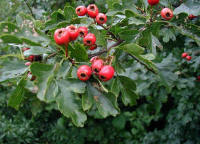 Hawberry
- Also called haws, the small, dark red berries of various species of hawthorn
trees (Crataegus genus) are so bitter and tart that they are considered
inedible in their raw state. They can be used to make jams and jellies, and are
often combined with crabapples for this purpose. Hawberry
- Also called haws, the small, dark red berries of various species of hawthorn
trees (Crataegus genus) are so bitter and tart that they are considered
inedible in their raw state. They can be used to make jams and jellies, and are
often combined with crabapples for this purpose.
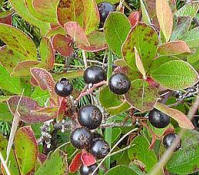 Huckleberry
- Almost identical in every respect to their close cousins blueberries,
huckleberries (Vaccinium myrtillus) have thicker skins, larger seeds,
and a more assertive flavor than their better-know relative. They can be used
exactly as blueberries. Although they grow wild throughout the northern United
States and southern Canada, they are not grown commercially so you aren't likely
to find them in your supermarket. Huckleberry
- Almost identical in every respect to their close cousins blueberries,
huckleberries (Vaccinium myrtillus) have thicker skins, larger seeds,
and a more assertive flavor than their better-know relative. They can be used
exactly as blueberries. Although they grow wild throughout the northern United
States and southern Canada, they are not grown commercially so you aren't likely
to find them in your supermarket.
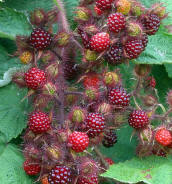 Hybrid
Berries - A number of crosses between blackberries (and their close relatives)
and raspberries (ditto), some of them natural and some of them man-made, are
available in one form or another. Since few of these berries are produced
commercially in large quantities, and given that ripe berries are too delicate
to transport effectively, they are usually available only in the form of jams or
jellies. Loganberries are a natural hybrid discovered in the Santa Cruz,
California garden of Judge J. H. Logan in 1881. Other blackberry-raspberry
hybrids often encountered are boysenberries, tayberries, youngberries,
wineberries, tummelberries, and sunberries. Hybrid
Berries - A number of crosses between blackberries (and their close relatives)
and raspberries (ditto), some of them natural and some of them man-made, are
available in one form or another. Since few of these berries are produced
commercially in large quantities, and given that ripe berries are too delicate
to transport effectively, they are usually available only in the form of jams or
jellies. Loganberries are a natural hybrid discovered in the Santa Cruz,
California garden of Judge J. H. Logan in 1881. Other blackberry-raspberry
hybrids often encountered are boysenberries, tayberries, youngberries,
wineberries, tummelberries, and sunberries.
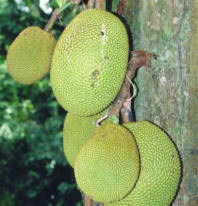 Jackfruit
- These large fruits can weigh up to 50 pounds (23 Kg), making them one of the
world's largest tree-borne fruits. The Artocarpus heterophyllus tree of
Southeast Asia is related to the breadfruit tree. The thick, spiny skin of the
fruits changes from green to brown as it ripens, and the soft, delicately
flavored pale yellow flesh can be eaten raw or cooked. The seeds are also edible
and are a popular snack, eaten roasted, boiled, and fried. Jackfruit
- These large fruits can weigh up to 50 pounds (23 Kg), making them one of the
world's largest tree-borne fruits. The Artocarpus heterophyllus tree of
Southeast Asia is related to the breadfruit tree. The thick, spiny skin of the
fruits changes from green to brown as it ripens, and the soft, delicately
flavored pale yellow flesh can be eaten raw or cooked. The seeds are also edible
and are a popular snack, eaten roasted, boiled, and fried.
 Jamaican
Plum - Know by a variety of names including Spanish plums, hoy plums, limbu, and
mombin, the Spondias purpurea plant of Central America is related to
mangos, and its fruit resembles them in many respects. The tart flesh surrounds
a large fibrous seed and must be teased away to be eaten, but the flavor is more
often compared to pineapple than to mangos. They can be used in fruit salads and
jams, chutneys, and frozen desserts exactly like mangos. Jamaican
Plum - Know by a variety of names including Spanish plums, hoy plums, limbu, and
mombin, the Spondias purpurea plant of Central America is related to
mangos, and its fruit resembles them in many respects. The tart flesh surrounds
a large fibrous seed and must be teased away to be eaten, but the flavor is more
often compared to pineapple than to mangos. They can be used in fruit salads and
jams, chutneys, and frozen desserts exactly like mangos.
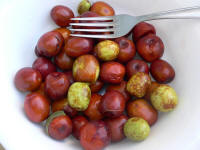 Jujube
- These small olive-sized fruits are variously known as Chinese dates, Chinese
apples, red, dates, and in India, bec and bor. The Chinese have been cultivating
Zizyphus jujuba for more than 4,000 years. The leathery green skin
gradually changes to rust-red and finally to brown as they ripen; the firm,
crisp white flesh has a texture similar to an apple; and the flavor hints of
prunes. They can be made into jams, jellies, and candies, and are often dried
and used in sweet and savory Chinese dishes. Jujube
- These small olive-sized fruits are variously known as Chinese dates, Chinese
apples, red, dates, and in India, bec and bor. The Chinese have been cultivating
Zizyphus jujuba for more than 4,000 years. The leathery green skin
gradually changes to rust-red and finally to brown as they ripen; the firm,
crisp white flesh has a texture similar to an apple; and the flavor hints of
prunes. They can be made into jams, jellies, and candies, and are often dried
and used in sweet and savory Chinese dishes.
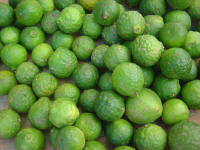 Kaffir
Lime - The leaves of the Citrus hystrix tree are used in Southeast
Asian cooking to lend a slightly floral citrus note to many soups and stews, and
the rind of the small, bumpy, green fruits is used in the same way. The flesh is
not customarily eaten. Kaffir
Lime - The leaves of the Citrus hystrix tree are used in Southeast
Asian cooking to lend a slightly floral citrus note to many soups and stews, and
the rind of the small, bumpy, green fruits is used in the same way. The flesh is
not customarily eaten.
Key Lime - See lime
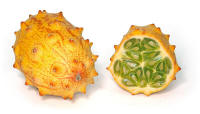 Kiwano
- Probably the strangest looking fruit ever seen in most American supermarkets,
these small, oblong fruits look like spiny, bright-orange little footballs. They
are native to New Zealand and, thanks to the excellent job the New Zealanders do
in providing much of the world with exotic fruits, they are widely available.
This member of the cucumber family (Cucumis metuliferus) is filled with
seeds covered in a jelly-like flesh similar to passion fruits, and are used in
drinks, fruit salads, and scooped out of their shell and eaten raw. Kiwano
- Probably the strangest looking fruit ever seen in most American supermarkets,
these small, oblong fruits look like spiny, bright-orange little footballs. They
are native to New Zealand and, thanks to the excellent job the New Zealanders do
in providing much of the world with exotic fruits, they are widely available.
This member of the cucumber family (Cucumis metuliferus) is filled with
seeds covered in a jelly-like flesh similar to passion fruits, and are used in
drinks, fruit salads, and scooped out of their shell and eaten raw.
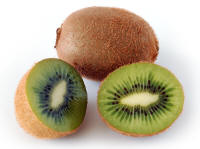 Kiwi
Fruit - One would never guess by looking at the dull, fuzzy brown exterior of a
kiwi fruit that inside lies a luscious and visually stunning surprise. The firm,
juicy flesh is bright green (in most varieties) and studded with tiny black
seeds arranged in spokes around a central core. Many descriptions refer to a
flavor that's a cross between a pineapple and a strawberry, but if you ask me,
they just taste like kiwi fruit. Although they were introduced to the world at
large by agronomists from New Zealand, and Actinidia sinensis is
actually native to China which accounts for their being called Chinese
gooseberries before the enterprising Kiwis took the fruit worldwide. Kiwis
continue to ripen after they are picked, so let them rest at room temperature
until they become a little soft to the touch, and then store them in the
refrigerator until you are ready to eat them. Kiwi fruits are much appreciated
for their eye appeal and are often used as a garnish for desserts and pastries,
but they are also valuable as a fruit in their own right. They can be eaten out
of hand (the skin is edible, although most people prefer to discard it), and
make wonderful jellies. However, they contain large amounts of an enzyme that
prevents gelatin from setting and curdles milk when raw, so should not be
included in gelatin desserts or milk-based preparations such as ice cream and
custard. Kiwi
Fruit - One would never guess by looking at the dull, fuzzy brown exterior of a
kiwi fruit that inside lies a luscious and visually stunning surprise. The firm,
juicy flesh is bright green (in most varieties) and studded with tiny black
seeds arranged in spokes around a central core. Many descriptions refer to a
flavor that's a cross between a pineapple and a strawberry, but if you ask me,
they just taste like kiwi fruit. Although they were introduced to the world at
large by agronomists from New Zealand, and Actinidia sinensis is
actually native to China which accounts for their being called Chinese
gooseberries before the enterprising Kiwis took the fruit worldwide. Kiwis
continue to ripen after they are picked, so let them rest at room temperature
until they become a little soft to the touch, and then store them in the
refrigerator until you are ready to eat them. Kiwi fruits are much appreciated
for their eye appeal and are often used as a garnish for desserts and pastries,
but they are also valuable as a fruit in their own right. They can be eaten out
of hand (the skin is edible, although most people prefer to discard it), and
make wonderful jellies. However, they contain large amounts of an enzyme that
prevents gelatin from setting and curdles milk when raw, so should not be
included in gelatin desserts or milk-based preparations such as ice cream and
custard.
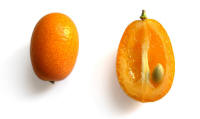 Kumquat
- Although kumquats are usually grouped with citrus fruits, they belong to a
different, albeit closely related, genus. The small fruits of the Fortunella
margarita have a thin, bright orange skin, orange flesh with small seeds,
and a citrus-like flavor that is both bitter and tart. They can be eaten whole,
skin and all, and are commonly found canned in syrup or alcohol. They make
excellent marmalade and jam, and can be cooked whole with poultry and pork. Kumquat
- Although kumquats are usually grouped with citrus fruits, they belong to a
different, albeit closely related, genus. The small fruits of the Fortunella
margarita have a thin, bright orange skin, orange flesh with small seeds,
and a citrus-like flavor that is both bitter and tart. They can be eaten whole,
skin and all, and are commonly found canned in syrup or alcohol. They make
excellent marmalade and jam, and can be cooked whole with poultry and pork.
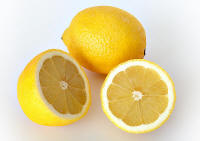 Lemon
- Probably the most versatile of the citrus fruits; the juice, flesh, and rind
of lemons are all used in an endless array of sweet and savory dishes of every
description. They can be eaten raw (although few of us relish the thought) or
cooked, the juice can be drunk (usually diluted and sweetened), and the rind
offers its unique flavor and aroma to everything from soups to candies. Lemons
often serve as little more than a garnish and are traditionally treated as such
in many seafood preparations, but they can also be a featured component-in North
Africa whole preserved lemons are often added to stews and tagines. Lemon
- Probably the most versatile of the citrus fruits; the juice, flesh, and rind
of lemons are all used in an endless array of sweet and savory dishes of every
description. They can be eaten raw (although few of us relish the thought) or
cooked, the juice can be drunk (usually diluted and sweetened), and the rind
offers its unique flavor and aroma to everything from soups to candies. Lemons
often serve as little more than a garnish and are traditionally treated as such
in many seafood preparations, but they can also be a featured component-in North
Africa whole preserved lemons are often added to stews and tagines.
The Citrus limon is believed to have originated in India
or Southeast Asia, and lemons, spread rapidly by the hands of ancient traders,
were well known to the early Mediterranean cultures. Their migrations were
subsequently aided by seafaring merchants and explorers who took them along to
fight scurvy and other diseases resulting from vitamin C depletion, and as a
result, lemons were probably the first alien crop introduced into many newly
discovered and conquered lands.
The same thing that made lemons popular for medical reasons also
makes them popular for culinary reasons. Their high content of citric and
ascorbic acids (also known as vitamin C) gives them an agreeable if somewhat
mouth-puckering tartness, and the low pH (high acidity) prevents oxidation and
acts as a preservative. This is why a little lemon juice in a bowl of water will
prevent vegetables such as potatoes and artichokes from turning brown. This same
chemical action also denatures proteins, and lemon juice can be used to
tenderize-and even "cook"-meats. In the case of seviche, raw fish is marinated
in lemon juice until the fish is firm and opaque, as if it had been cooked.
(Another way to denature proteins is through heat, so in a technical sense, the
lemon juice really does cook the fish.)
Although there are dozens varieties of lemons differing primarily
in the size of the fruit and the thickness of the rind, they all share the
characteristic bright yellow skin, sharp acidity, and unique flavor.
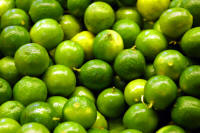 Lime
- There are actually two different fruits known around the world as limes. The
large, bright green lemon-shaped fruits of the Citrus latifolia tree
are those most familiar to Europeans and North Americans. Also known as Persian
and Tahitian limes, their flesh, rind, and juice are used the same as lemons.
The smaller, rounder fruits of the Citrus aurantifolia tree, usually no
larger than a walnut, are variously known as Key limes, Mexican limes, and West
Indian limes. Their flavor is very similar to Persian limes but they tend to be
bitter and are not suitable for many preparations for which lemons and Persian
limes are well suited, such as marmalades and preserves. Like Persian limes,
their juice can be used in sauces, beverages, and marinades, and is available in
bottles. Unlike lemons which prefer a cooler climate, both types of limes are at
home in tropical as well as sub-tropical conditions, and are often used as (and
even called) lemons in those areas where true lemons will not grow. Lime
- There are actually two different fruits known around the world as limes. The
large, bright green lemon-shaped fruits of the Citrus latifolia tree
are those most familiar to Europeans and North Americans. Also known as Persian
and Tahitian limes, their flesh, rind, and juice are used the same as lemons.
The smaller, rounder fruits of the Citrus aurantifolia tree, usually no
larger than a walnut, are variously known as Key limes, Mexican limes, and West
Indian limes. Their flavor is very similar to Persian limes but they tend to be
bitter and are not suitable for many preparations for which lemons and Persian
limes are well suited, such as marmalades and preserves. Like Persian limes,
their juice can be used in sauces, beverages, and marinades, and is available in
bottles. Unlike lemons which prefer a cooler climate, both types of limes are at
home in tropical as well as sub-tropical conditions, and are often used as (and
even called) lemons in those areas where true lemons will not grow.
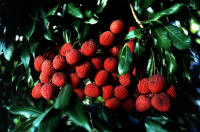 Litchi
- Also spelled litchee, lichi, and lychee, it's pronounce LEE-chee no matter how
you spell it. The small, egg-shaped fruits of the Litchi sinensis tree
of China have a distinctive bumpy brick-red, thin leathery skin surrounding
thick, translucent jelly-like flesh and a single large, inedible brown seed.
They have been cultivated in China for at least 2,000 years are now grown in
subtropical regions around the world, including California, Hawaii, and Florida.
Fresh litchis are often available in June and July, and canned litchis are also
readily available thanks to their popularity in Chinese cuisine. When dried they
are known as litchi nuts and are often treated as a snack food. Litchi
- Also spelled litchee, lichi, and lychee, it's pronounce LEE-chee no matter how
you spell it. The small, egg-shaped fruits of the Litchi sinensis tree
of China have a distinctive bumpy brick-red, thin leathery skin surrounding
thick, translucent jelly-like flesh and a single large, inedible brown seed.
They have been cultivated in China for at least 2,000 years are now grown in
subtropical regions around the world, including California, Hawaii, and Florida.
Fresh litchis are often available in June and July, and canned litchis are also
readily available thanks to their popularity in Chinese cuisine. When dried they
are known as litchi nuts and are often treated as a snack food.
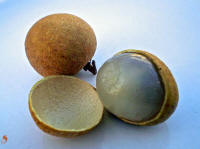 Longan
- These distant relatives of the litchi share many of the same characteristics.
The small round or oval fruits of the Euphoria longana tree are covered
by a thin, inedible brown skin which, when peeled back, reveals a translucent
white flesh surrounding a large, inedible seed. They have a subtle, sweet flavor
similar to litchis. They can occasionally be bought fresh, usually in large
clusters still attached to the stems, and they are available canned in syrup. In
China they are known as Dragon's eyes and are used, usually whole, in sweet and
savory dishes. Longan
- These distant relatives of the litchi share many of the same characteristics.
The small round or oval fruits of the Euphoria longana tree are covered
by a thin, inedible brown skin which, when peeled back, reveals a translucent
white flesh surrounding a large, inedible seed. They have a subtle, sweet flavor
similar to litchis. They can occasionally be bought fresh, usually in large
clusters still attached to the stems, and they are available canned in syrup. In
China they are known as Dragon's eyes and are used, usually whole, in sweet and
savory dishes.
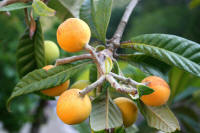 Loquat
- A member of the apple family, loquats (Eriobotya japonica) are native
to Japan and China. The small, apricot-sized fruits have a thin, yellow or
orange edible skin and crisp, white or yellow flesh with a fresh, tart flavor
that reminds one of sour cherries. Also known as Japanese plums and Japanese
medlars, they can be eaten out of hand or used to make jams and chutneys. They
can also be added to chicken or duck dishes and are available dried and canned
in Asian specialty shops. Loquat
- A member of the apple family, loquats (Eriobotya japonica) are native
to Japan and China. The small, apricot-sized fruits have a thin, yellow or
orange edible skin and crisp, white or yellow flesh with a fresh, tart flavor
that reminds one of sour cherries. Also known as Japanese plums and Japanese
medlars, they can be eaten out of hand or used to make jams and chutneys. They
can also be added to chicken or duck dishes and are available dried and canned
in Asian specialty shops.
Mandarin - See tangerine
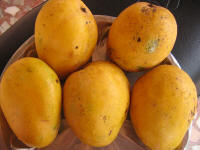 Mango
- There are thousands of varieties of mangos thanks in large part to their
tremendous popularity in tropical climates around the world. This popularity has
led to a great deal of diversity in the fruits of the Mangifera indica
tree native to India, and its fruits vary greatly in size, shape, color, and
flavor. Most mangos that reach American consumers are curved, oblong fruits with
a thin green, yellow, orange, or red skin and sweet, distinctly-flavored soft
golden flesh surrounding a large, fibrous central pit. The majority of mangos
are eaten out of hand or in fruit salads, but they are also processed into jams,
jellies, and chutneys (the famous Major Grey's is an example), and the bottled
or canned juice is sold as mango nectar. Green mangos, the unripe fruits,
feature prominently in the cooking of India and Southeast Asia, and in dried
powdered form are known as amchoor, or mango powder in India. Keep
under-ripe mangos in a paper bag at room temperature until they yield slightly
to gentle pressure (like a peach or pear), and then store them in the
refrigerator. Mango
- There are thousands of varieties of mangos thanks in large part to their
tremendous popularity in tropical climates around the world. This popularity has
led to a great deal of diversity in the fruits of the Mangifera indica
tree native to India, and its fruits vary greatly in size, shape, color, and
flavor. Most mangos that reach American consumers are curved, oblong fruits with
a thin green, yellow, orange, or red skin and sweet, distinctly-flavored soft
golden flesh surrounding a large, fibrous central pit. The majority of mangos
are eaten out of hand or in fruit salads, but they are also processed into jams,
jellies, and chutneys (the famous Major Grey's is an example), and the bottled
or canned juice is sold as mango nectar. Green mangos, the unripe fruits,
feature prominently in the cooking of India and Southeast Asia, and in dried
powdered form are known as amchoor, or mango powder in India. Keep
under-ripe mangos in a paper bag at room temperature until they yield slightly
to gentle pressure (like a peach or pear), and then store them in the
refrigerator.
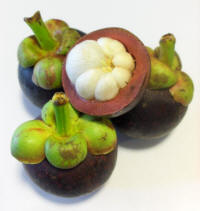 Mangosteen
- It's a pity the small, round fruits of the Garcinia mangostana tree
aren't available outside of their native range in Southeast Asia because the
succulent flesh is sweet, tart, and refreshing. The pale flesh surrounds several
large inedible seeds arranged in segments inside a thick, pithy shell and smooth
outer skin, both the color of oxblood. They are rarely cooked or included in
fruit salads and are usually just eaten out of hand. Experienced mangosteen
eaters are cautious of the juicy inedible pulp they must dig through in order to
get to the fruit because it stains everything it touches. Mangosteen
- It's a pity the small, round fruits of the Garcinia mangostana tree
aren't available outside of their native range in Southeast Asia because the
succulent flesh is sweet, tart, and refreshing. The pale flesh surrounds several
large inedible seeds arranged in segments inside a thick, pithy shell and smooth
outer skin, both the color of oxblood. They are rarely cooked or included in
fruit salads and are usually just eaten out of hand. Experienced mangosteen
eaters are cautious of the juicy inedible pulp they must dig through in order to
get to the fruit because it stains everything it touches.
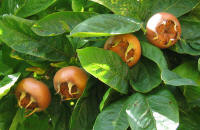 Medlar
- Medlars were more popular in the past than they are now, even though a 19th
century horticulturist described them all as "of equal unpleasantness." A
relative of apples and pears, the distinctive round fruit of the Mespilus
germanica tree has five elongated appendages at the flower end of the fruit
but otherwise resembles a small apple. They are never eaten fresh or raw, and
were traditionally allowed to rot for several weeks in a process known as
"bletting" before being consumed. The firm flesh of the medlar becomes soft and
sticky after bletting and can be scooped out of its skin with a spoon. They were
processed into jams and jellies, and were valued for their wine-like flavor.
Medlars are not grown commercially but may be found growing wild in Europe,
Asia, and even North America where they escaped from backyard gardens. Medlar
- Medlars were more popular in the past than they are now, even though a 19th
century horticulturist described them all as "of equal unpleasantness." A
relative of apples and pears, the distinctive round fruit of the Mespilus
germanica tree has five elongated appendages at the flower end of the fruit
but otherwise resembles a small apple. They are never eaten fresh or raw, and
were traditionally allowed to rot for several weeks in a process known as
"bletting" before being consumed. The firm flesh of the medlar becomes soft and
sticky after bletting and can be scooped out of its skin with a spoon. They were
processed into jams and jellies, and were valued for their wine-like flavor.
Medlars are not grown commercially but may be found growing wild in Europe,
Asia, and even North America where they escaped from backyard gardens.
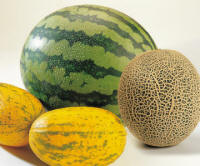 Melons
- Members of the huge Cucurbitaceae family that includes cucumbers,
squashes, and gourds, there are literally thousands of species of melons growing
wild and in cultivation around the world. Botanists believe they originated in
Africa, and they were being cultivated in China at least 3,000 years ago. Most
authorities divide the edible melons into two categories: muskmelons and
watermelons. They are characterized by their oval or round shape, a thick edible
(though often unpalatable) rind, and very juicy flesh surrounding numerous seeds
which are often located in a cavity in the center of the fruit. See muskmelons
and watermelons. Melons
- Members of the huge Cucurbitaceae family that includes cucumbers,
squashes, and gourds, there are literally thousands of species of melons growing
wild and in cultivation around the world. Botanists believe they originated in
Africa, and they were being cultivated in China at least 3,000 years ago. Most
authorities divide the edible melons into two categories: muskmelons and
watermelons. They are characterized by their oval or round shape, a thick edible
(though often unpalatable) rind, and very juicy flesh surrounding numerous seeds
which are often located in a cavity in the center of the fruit. See muskmelons
and watermelons.
Mineola - See tangerines
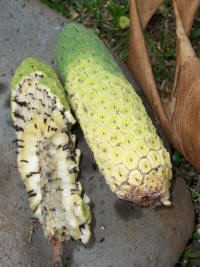 Monstera
- Picture a foot-long, narrow green pinecone and you'll have a pretty good idea
what to look for when shopping for monstera. The fruit of the Monstera
deliciosa plant native to Central America (often sold as house plants as
split-leaf philodendrons) is covered with geometric scales attached to the ends
of segments of soft, custard-like flesh attached around a central core. Its
flavor is usually described as a combination of banana, pineapple, and mango.
The fruit ripens gradually, beginning at the thick end and gradually working
towards the tip of the fruit. As the individual segments ripen, the outer
scale-like covering becomes loose, indicating that it is ready to be eaten. If
eaten before it's ripe, the fruit has an irritating and slightly toxic effect. Monstera
- Picture a foot-long, narrow green pinecone and you'll have a pretty good idea
what to look for when shopping for monstera. The fruit of the Monstera
deliciosa plant native to Central America (often sold as house plants as
split-leaf philodendrons) is covered with geometric scales attached to the ends
of segments of soft, custard-like flesh attached around a central core. Its
flavor is usually described as a combination of banana, pineapple, and mango.
The fruit ripens gradually, beginning at the thick end and gradually working
towards the tip of the fruit. As the individual segments ripen, the outer
scale-like covering becomes loose, indicating that it is ready to be eaten. If
eaten before it's ripe, the fruit has an irritating and slightly toxic effect.
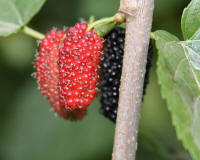 Mulberry
- There are three types of mulberry trees of the Morus genus. The
fruits of the black mulberry are actually dark purple, and the tree is found
growing wild all over Asia and Europe. Many European black mulberry trees are
descended from trees that were planted (in the misguided belief that silk worms
would feed on them) in several early attempts to break the Chinese monopoly on
silk production. In reality, the finicky larvae of the silk moth only eat the
leaves of the white mulberry, which grows primarily in Central Asia and whose
fruits are actually more yellow than white in color. The aptly-named red
mulberry is a North American native and its fruits are, as you might have
guessed, red. All three types of mulberries grow on enormous trees (up to 50
feet tall and 50 feet across) and they all resemble large blackberries. They are
sweet enough to be eaten without benefit of added sweeteners, and they make
excellent jam, jelly, ice cream, and sorbet. Mulberry
- There are three types of mulberry trees of the Morus genus. The
fruits of the black mulberry are actually dark purple, and the tree is found
growing wild all over Asia and Europe. Many European black mulberry trees are
descended from trees that were planted (in the misguided belief that silk worms
would feed on them) in several early attempts to break the Chinese monopoly on
silk production. In reality, the finicky larvae of the silk moth only eat the
leaves of the white mulberry, which grows primarily in Central Asia and whose
fruits are actually more yellow than white in color. The aptly-named red
mulberry is a North American native and its fruits are, as you might have
guessed, red. All three types of mulberries grow on enormous trees (up to 50
feet tall and 50 feet across) and they all resemble large blackberries. They are
sweet enough to be eaten without benefit of added sweeteners, and they make
excellent jam, jelly, ice cream, and sorbet.
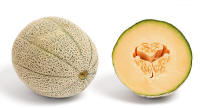 Muskmelon
- Hundreds, or maybe thousands of varieties of Cucumis melo are readily
available throughout the world. They are distinguished from the other main
category of melons (see watermelons) by their thick, dense flesh and the central
cavity that houses the seeds. Muskmelons are further divided into two main
categories: summer and winter melons. The summer muskmelons have a crosshatched
or netted texture on their skins, and winter muskmelons have smooth or finely
ridged skins. Their skins can range in color from a drab brown to vivid yellow
or green and can be netted or smooth, and their flesh ranges in color from ivory
to pale green to yellow and salmon. The most common muskmelon in American
supermarkets is probably the cantaloupe (named after the Italian city of
Cantalupo and the muskmelons grown there), and honeydew, Persian, casaba, Santa
Claus, Crenshaw, and Charentais melons are also frequently available. Muskmelon
- Hundreds, or maybe thousands of varieties of Cucumis melo are readily
available throughout the world. They are distinguished from the other main
category of melons (see watermelons) by their thick, dense flesh and the central
cavity that houses the seeds. Muskmelons are further divided into two main
categories: summer and winter melons. The summer muskmelons have a crosshatched
or netted texture on their skins, and winter muskmelons have smooth or finely
ridged skins. Their skins can range in color from a drab brown to vivid yellow
or green and can be netted or smooth, and their flesh ranges in color from ivory
to pale green to yellow and salmon. The most common muskmelon in American
supermarkets is probably the cantaloupe (named after the Italian city of
Cantalupo and the muskmelons grown there), and honeydew, Persian, casaba, Santa
Claus, Crenshaw, and Charentais melons are also frequently available.
Anyone who has ever tasted the juicy sweetness of a ripe
muskmelon already knows that they are mostly water, and although the
orange-fleshed varieties contain significant amounts of beta-carotene, there is
little to recommend them from a nutritional point of view. Much has been written
about how to pick a ripe melon, but there are so many different varieties with
differing characteristics that it is difficult to generalize. Some muskmelons
smell fresh and "melony" when ripe, and other do not, so don't let your nose be
your only guide. Choose melons that are heavy for their size, and whose blossom
end (the dimple) yields slightly when pressed with your thumb. Although they
will continue to ripen when stored at room temperature, they will never taste as
sweet as those that matured on the vine, so buy your muskmelons as ripe as you
can, and eat them as soon as you can.
The delicate flavor of most melons is lost in cooking, so the
vast majority of muskmelons are eaten fresh and raw, alone or as part of fruit
salads. They are also good with cheese, and the more strongly flavored varieties
make wonderful ice creams and sorbets.
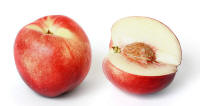 Nectarine
- Nectarines are natural mutations (called sports) of peaches and are identical
to peaches except that their skin is smooth rather than fuzzy. In spite of what
most food writers would have you believe, the differences between peaches and
nectarines (some say one is sweeter, or stronger flavored, or firmer textured)
are no greater than the differences between any two types of peaches, and any
imagined difference is due to this variability rather than a hard-and-fast
distinction between the two fruits. They can be propagated by seed or by
cuttings, but either way, a nectarine tree might produce peaches and vice
versa-it is not uncommon the see both fruits on a single tree. See peaches. Nectarine
- Nectarines are natural mutations (called sports) of peaches and are identical
to peaches except that their skin is smooth rather than fuzzy. In spite of what
most food writers would have you believe, the differences between peaches and
nectarines (some say one is sweeter, or stronger flavored, or firmer textured)
are no greater than the differences between any two types of peaches, and any
imagined difference is due to this variability rather than a hard-and-fast
distinction between the two fruits. They can be propagated by seed or by
cuttings, but either way, a nectarine tree might produce peaches and vice
versa-it is not uncommon the see both fruits on a single tree. See peaches.
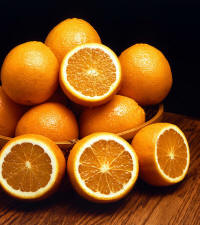 Orange
- Oranges account for almost 75 percent of the citrus fruits grown worldwide.
Although most of them bear their namesake color, green, yellow and red-mottled
oranges also exist, and some oranges will actually change from orange to green
after they have ripened. The fruits of the Citrus sinensis, native to
China and Southeast Asia, can be divided into two categories: sweet, and bitter. Orange
- Oranges account for almost 75 percent of the citrus fruits grown worldwide.
Although most of them bear their namesake color, green, yellow and red-mottled
oranges also exist, and some oranges will actually change from orange to green
after they have ripened. The fruits of the Citrus sinensis, native to
China and Southeast Asia, can be divided into two categories: sweet, and bitter.
Most of the oranges you are likely to find in your supermarket
are sweet oranges. This group includes the ubiquitous Valencia orange, the most
widely cultivated variety. It is best eaten fresh and raw, and provides most of
the orange juice sold commercially. Navel oranges are a probably a natural
mutation that occurred in China several thousand years ago. The navel-like
indentation at the flower end of the fruit is actually a small seed-bearing
embryonic orange within an orange, leaving the main fruit seedless. Navel
oranges are prized for their sweet flavor low in acidity and because the peel is
easily removed from the fruit, making it a natural and easy-to-eat snack food.
However, the juice from navel oranges will quickly turn extremely bitter due to
enzymatic action that begins when the cell walls are broken. Blood oranges have
flesh that is tinged pink in some varieties and deep maroon in others, and with
every shade in between. These are the most widely cultivated oranges in Italy,
and their flesh and juice are valued not only for their sweet flavor tinged with
a hint of raspberries, but for their high concentration of antioxidants as well.
Bitter oranges are rarely found in supermarkets these days. This
is ironic because, up until about 200 years ago, bitter oranges were the only
oranges available outside of Asia. Nowadays they are used primarily for
preserves and as a flavoring agent, and are considered too bitter (and, in some
cases, too sour as well) to be eaten raw. Seville oranges are used to make
marmalade, and although Spain is the world's largest producer, the bulk of the
harvest is shipped to England for processing into their favorite breakfast
spread. The peels also lend their characteristic flavor to liqueurs such as
Grand Marnier and Cointreau.
The flowers of the orange tree produce a delicate sweet fragrance
that is distilled into orange flower water and used to add flavor and aroma to
pastries and beverages.
Oranges are justifiably acclaimed for their vitamin C content-a
single orange provides about twice the recommended daily allotment. Be aware
that the vitamin C in orange juice begins to decline immediately after being
squeezed-after only 24 hours in the refrigerator as much as 20 percent of the
vitamin C will have dissipated-so drink freshly-squeezed orange juice for the
maximum health benefit. Oranges are also high in dietary fiber.
Ortanique - See tangerine
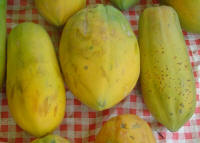 Papaya
- In spite of their many melon-like characteristics, the Carica papaya
of Central America and the Caribbean isn't even remotely related to melons. The
fruits have smooth skins, usually yellow to orange in color, pink or
salmon-colored flesh, and many round edible seeds with a peppery flavor.
Hundreds of varieties are grown in tropical and subtropical climates around the
world, most of them ranging in size from about 6 to 12 inches (15-30 cm) in
length. The plant is something of a botanical wonder because it will grow from
seed to a height of 12 feet (3.6 m) and produce fruit in as little as 12 months.
The fruits grow directly out of the thick trunk of the tree (actually a large
herb) near the umbrella of large star-shaped leaves at the top. The juicy flesh,
which is often compared to melons and peaches in texture and flavor, contains
large amounts of the enzyme papain that is used as a meat tenderizer. They are
usually eaten raw, and canned or bottled papaya juice is sold as papaya nectar.
Under-ripe green papayas are treated as vegetables in the cooking of the
Caribbean region and parts of Southeast Asia. Papaya
- In spite of their many melon-like characteristics, the Carica papaya
of Central America and the Caribbean isn't even remotely related to melons. The
fruits have smooth skins, usually yellow to orange in color, pink or
salmon-colored flesh, and many round edible seeds with a peppery flavor.
Hundreds of varieties are grown in tropical and subtropical climates around the
world, most of them ranging in size from about 6 to 12 inches (15-30 cm) in
length. The plant is something of a botanical wonder because it will grow from
seed to a height of 12 feet (3.6 m) and produce fruit in as little as 12 months.
The fruits grow directly out of the thick trunk of the tree (actually a large
herb) near the umbrella of large star-shaped leaves at the top. The juicy flesh,
which is often compared to melons and peaches in texture and flavor, contains
large amounts of the enzyme papain that is used as a meat tenderizer. They are
usually eaten raw, and canned or bottled papaya juice is sold as papaya nectar.
Under-ripe green papayas are treated as vegetables in the cooking of the
Caribbean region and parts of Southeast Asia.
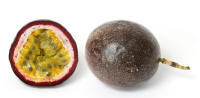 Passion
Fruit - The Passiflora edulis vine takes its name from its blossoms-the
different parts of the flower are said to represent different aspects of the
crucifixion of Christ. The ovoid fruits, usually about 3 inches (7 cm) in
length, have a smooth purple skin that becomes dimpled or wrinkled when fully
ripe. The interior contains several small black edible seeds which are
surrounded by an orange, jelly-like coating that has a distinctive, sweet-tart
flavor and delicate floral aroma. They are called lilikoi in Hawaii, and are
often confused with granadillas. They are good for eating fresh, seeds and all,
or the pulp can be strained to make a smooth coulis which is used in beverages
and sauces. They are grown commercially in Florida, California, Hawaii,
Australia, New Zealand, and in their native Brazil, and are available in markets
through most of the year. Passion
Fruit - The Passiflora edulis vine takes its name from its blossoms-the
different parts of the flower are said to represent different aspects of the
crucifixion of Christ. The ovoid fruits, usually about 3 inches (7 cm) in
length, have a smooth purple skin that becomes dimpled or wrinkled when fully
ripe. The interior contains several small black edible seeds which are
surrounded by an orange, jelly-like coating that has a distinctive, sweet-tart
flavor and delicate floral aroma. They are called lilikoi in Hawaii, and are
often confused with granadillas. They are good for eating fresh, seeds and all,
or the pulp can be strained to make a smooth coulis which is used in beverages
and sauces. They are grown commercially in Florida, California, Hawaii,
Australia, New Zealand, and in their native Brazil, and are available in markets
through most of the year.
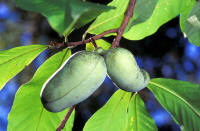 Pawpaw
- This North American native is often confused with the papaya because they are
both often called pawpaw. The pawpaw (Asimina triloba) is related to
the cherimoyas and has a similar, custard-like flesh peppered with hundreds of
tiny seeds and with a flavor reminiscent of bananas. Pawpaw
- This North American native is often confused with the papaya because they are
both often called pawpaw. The pawpaw (Asimina triloba) is related to
the cherimoyas and has a similar, custard-like flesh peppered with hundreds of
tiny seeds and with a flavor reminiscent of bananas.
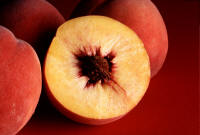 Peach
- Their succulent flesh and unique flavor make peaches one of the most popular
stone fruits worldwide. Native to China but known to the people of the
Mediterranean area since ancient times, both its Latin name and its erstwhile
nickname Persian apple hint at its progress through the Middle East on its
journey to Europe. Most of the fruits of the Prunus persica tree are
round with a pointed end (called a beak), fuzzy skin, and flesh that is usually
described as peach-colored, but many varieties are flat and disk-shaped, and the
flesh can range from creamy white to almost red in color. They are generally
classified in two categories: clingstones, whose flesh clings tenaciously to the
pit and are grown primarily for commercial processing; and freestones, whose
flesh separates easily from the pit and are grown primarily for the retail
market. Peach
- Their succulent flesh and unique flavor make peaches one of the most popular
stone fruits worldwide. Native to China but known to the people of the
Mediterranean area since ancient times, both its Latin name and its erstwhile
nickname Persian apple hint at its progress through the Middle East on its
journey to Europe. Most of the fruits of the Prunus persica tree are
round with a pointed end (called a beak), fuzzy skin, and flesh that is usually
described as peach-colored, but many varieties are flat and disk-shaped, and the
flesh can range from creamy white to almost red in color. They are generally
classified in two categories: clingstones, whose flesh clings tenaciously to the
pit and are grown primarily for commercial processing; and freestones, whose
flesh separates easily from the pit and are grown primarily for the retail
market.
Peaches are available fresh year round nearly everywhere thanks
to their global popularity, but are best during their peak season in late
summer. They are also nearly universally available canned, dried, and in the
form of jams and preserves. They are used in all manner of dishes, most of them
sweet, but can also be found in savory dishes from the Middle East and Latin
America.
Ripe peaches should yield slightly to gentle pressure, and
ripening can be hastened by storing them in a paper bag at room temperature.
Placing an apple (or just about any other ripe fruit) in the bag with the
peaches will speed the process. Once ripe, peaches should be stored in the
refrigerator and allowed to come to room temperature for maximum flavor.
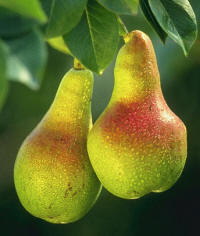 Pear
- Pears rank second only to apples in the number of varieties in cultivation,
but you are a very lucky person if you live in an area where more than half a
dozen varieties are to be found in markets. Most of them display their eponymous
shape, but some are round and apple-like in appearance. Their skin ranges in
color from green to yellow, rusty gold, and ruby red when ripe, and their flesh
(which is almost always off-white or very pale green) ranges from crisp and
crunchy to soft and succulent in texture. The Pyrus communis tree is
native to Europe and Asia, but it is now grown in temperate climates on every
continent except Antarctica. Although some varieties are considered inedible
when raw and are only used for canning and making preserves, most of the pears
grown around the world are destined to be eaten out of hand. Pears are easily
harvested and travel well because they can be picked while they're still
under-ripe-they actually improve in flavor and texture after being picked, a
talent rare among fruits. Pear
- Pears rank second only to apples in the number of varieties in cultivation,
but you are a very lucky person if you live in an area where more than half a
dozen varieties are to be found in markets. Most of them display their eponymous
shape, but some are round and apple-like in appearance. Their skin ranges in
color from green to yellow, rusty gold, and ruby red when ripe, and their flesh
(which is almost always off-white or very pale green) ranges from crisp and
crunchy to soft and succulent in texture. The Pyrus communis tree is
native to Europe and Asia, but it is now grown in temperate climates on every
continent except Antarctica. Although some varieties are considered inedible
when raw and are only used for canning and making preserves, most of the pears
grown around the world are destined to be eaten out of hand. Pears are easily
harvested and travel well because they can be picked while they're still
under-ripe-they actually improve in flavor and texture after being picked, a
talent rare among fruits.
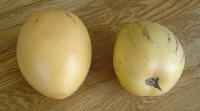 Pepino
- With their purple-streaked golden skin, the fruits of the Solanum
muricatum tree of Peru are among the most attractive of all fruits. Ranging
in size from that a plum to that of a large papaya, the juicy yellow flesh with
its edible seeds is often compared to melons and pineapples in flavor. Pepinos
(also called tree melons and melon pears) can be eaten out of hand, but they
benefit from some added sugar to counteract their tartness. Pepino
- With their purple-streaked golden skin, the fruits of the Solanum
muricatum tree of Peru are among the most attractive of all fruits. Ranging
in size from that a plum to that of a large papaya, the juicy yellow flesh with
its edible seeds is often compared to melons and pineapples in flavor. Pepinos
(also called tree melons and melon pears) can be eaten out of hand, but they
benefit from some added sugar to counteract their tartness.
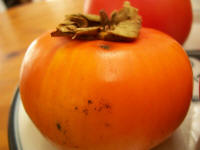 Persimmon
- Hundreds of varieties of persimmons grow wild throughout the northern
hemisphere, but a native of Japan (Diospyros kaki) is the one we
occasionally find in markets. Most are round or plum-shaped and have a brilliant
orange skin when ripe. The flesh is similarly colored and very sweet, with a
custard-like consistency. The skin is inedible, as is the entire fruit unless it
is completely ripe-under-ripe fruits are unbelievably astringent and
mouth-puckering. Persimmons continue to ripen after being picked, and many
aficionados let them sit at room temperature for as much as several weeks in
order to fully ripen them. They are excellent for out-of-hand eating, and can be
dried and used as dates or dried figs in sweets and baked goods. Persimmon
- Hundreds of varieties of persimmons grow wild throughout the northern
hemisphere, but a native of Japan (Diospyros kaki) is the one we
occasionally find in markets. Most are round or plum-shaped and have a brilliant
orange skin when ripe. The flesh is similarly colored and very sweet, with a
custard-like consistency. The skin is inedible, as is the entire fruit unless it
is completely ripe-under-ripe fruits are unbelievably astringent and
mouth-puckering. Persimmons continue to ripen after being picked, and many
aficionados let them sit at room temperature for as much as several weeks in
order to fully ripen them. They are excellent for out-of-hand eating, and can be
dried and used as dates or dried figs in sweets and baked goods.
Physalis - See cape gooseberry
Pineapple Guava - See feijoa
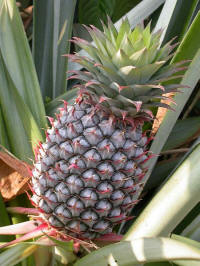 Pineapple
- A symbol of hospitality since Elizabethan times when returning seafarers would
place one on the fence post to indicate that the voyager was at home and
receiving visitors, the pineapple was "discovered" by Columbus when Caribbean
islanders shared the fruit they had been cultivating for thousands of years. The
Ananas comosus is the only member of the enormous family of bromeliads
whose fruit regularly finds its way to our tables. The large, bulbous fruits
with the decorative topknot of spiked leaves are actually composed of many
individual fruits-each of the diamond-shaped sections on the skin is a an
individual fruit resulting from individual flowers. Their unique, sweet-tart
flavor makes pineapples a welcome addition to many dishes. They are used in
desserts, pastries, beverages, ice cream, candies, and every other sort of sweet
confection, and are featured in many savory dishes as well, especially as a
garnish for ham, chicken, and pork. Pineapple can be grilled, sauteed, battered
and fried, baked, poached, pureed, and preserved, but it is probably best when
eaten fresh and raw. It is almost universally available fresh, canned, dried,
candied, and as pineapple juice. There are several hundred varieties in
cultivation around the world ranging in size from miniature fruits to whoppers
weighing over 10 pounds (4.5 Kg), but they are rarely sold by name. Pineapple
- A symbol of hospitality since Elizabethan times when returning seafarers would
place one on the fence post to indicate that the voyager was at home and
receiving visitors, the pineapple was "discovered" by Columbus when Caribbean
islanders shared the fruit they had been cultivating for thousands of years. The
Ananas comosus is the only member of the enormous family of bromeliads
whose fruit regularly finds its way to our tables. The large, bulbous fruits
with the decorative topknot of spiked leaves are actually composed of many
individual fruits-each of the diamond-shaped sections on the skin is a an
individual fruit resulting from individual flowers. Their unique, sweet-tart
flavor makes pineapples a welcome addition to many dishes. They are used in
desserts, pastries, beverages, ice cream, candies, and every other sort of sweet
confection, and are featured in many savory dishes as well, especially as a
garnish for ham, chicken, and pork. Pineapple can be grilled, sauteed, battered
and fried, baked, poached, pureed, and preserved, but it is probably best when
eaten fresh and raw. It is almost universally available fresh, canned, dried,
candied, and as pineapple juice. There are several hundred varieties in
cultivation around the world ranging in size from miniature fruits to whoppers
weighing over 10 pounds (4.5 Kg), but they are rarely sold by name.
Pineapples contain large amounts of the enzyme bromelin which,
like the papain derived from papayas, is used as a meat tenderizer, and this
same enzyme aids in digestion and makes fresh pineapple an excellent choice for
dessert after a heavy meal. Bromelin also prevents gelatin from setting, but
cooking destroys the enzyme so only cooked or canned pineapple (which has been
cooked in the canning process) should be added to gelatin-based desserts.
Choose pineapples that feel heavy for their size, and buy those
that are ripe and ready to eat because, although they will become less tart
after being picked, they are no longer able to convert starches to sugar and
won't get any sweeter. Test for ripeness by pulling one of the lower leaves in
the crown-if it detaches easily, the pineapple is ripe.
Pitahaya - See dragon fruit
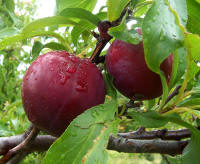 Plum
- Thousands of varieties of plums are enjoyed around the world. Their skins can
be just about any color from bright green and yellow to golden orange, deep red,
indigo blue, and dark purple. Their juicy flesh is a little more consistent in
color, usually yellow or orange. They grow in clusters and range in size from
tiny wild plums the size of olives to larger cultivated varieties about 3 inches
(7 cm) in diameter. Many species of the Prunus genus (which also
includes peaches, apricots, and almonds) are collectively known as plums. Most
are sweet enough to eat out of hand, but several are better suited to cooking
and preserving in jams or jellies. Some have bitter, unpalatable skins, but the
skins of most are enjoyably tart and tender. Plum
- Thousands of varieties of plums are enjoyed around the world. Their skins can
be just about any color from bright green and yellow to golden orange, deep red,
indigo blue, and dark purple. Their juicy flesh is a little more consistent in
color, usually yellow or orange. They grow in clusters and range in size from
tiny wild plums the size of olives to larger cultivated varieties about 3 inches
(7 cm) in diameter. Many species of the Prunus genus (which also
includes peaches, apricots, and almonds) are collectively known as plums. Most
are sweet enough to eat out of hand, but several are better suited to cooking
and preserving in jams or jellies. Some have bitter, unpalatable skins, but the
skins of most are enjoyably tart and tender.
Most plums are enjoyed raw and fresh. They make excellent
additions to fruit salads and are often cooked in pies and other pastries. They
also appear in jams, jellies, and preserves, and lend a delicate aroma to plum
brandies and liqueurs.
Dried plums are known as prunes and, although technically any
kind of plum can be dried and called a prune, several special varieties are
grown for this purpose. Traditionally they were allowed to dry on the tree
giving them a pleasant, winey flavor, but most modern prunes are produced
through sun-drying.
Damson plums (Prunus institia) are dark purple-almost
black-and have a characteristic sweet flavor. They are sometimes available in
American supermarkets, but the bulk of commercial production goes to can fruit
and preserves.
Buy plums that are firm but yield slightly to pressure.
Under-ripe plums will ripen if allowed to sit at room temperature for a day or
two, and as with most fruits, ripe plums should be refrigerated to preserve
their flavor and freshness.
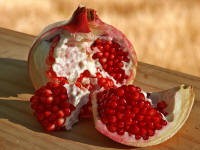 Pomegranate
- Some scholars suggest that the apple in the Garden of Eden was actually a
pomegranate, a thesis supported by the fact that the Punica granatum
tree is native to the Middle East. Probably the most labor intensive of all
fruits, the small white seeds are covered by a translucent pink or red flesh and
must be coaxed from the inedible yellow pith that runs seemingly at random
throughout the fruit. The skin is thick and leather-like, and usually deep red
or gold in color. Pomegranate
- Some scholars suggest that the apple in the Garden of Eden was actually a
pomegranate, a thesis supported by the fact that the Punica granatum
tree is native to the Middle East. Probably the most labor intensive of all
fruits, the small white seeds are covered by a translucent pink or red flesh and
must be coaxed from the inedible yellow pith that runs seemingly at random
throughout the fruit. The skin is thick and leather-like, and usually deep red
or gold in color.
The seeds can be eaten whole, or the tart flesh can be removed by
squeezing or gently straining through a sieve. They make an attractive garnish
to salads and savory dishes, and in India they are added to meat dishes. The
juice is used in sauces and beverages, and is made into the sweet syrup known as
grenadine. Nowadays most brands of grenadine contain little more than sugar
syrup and food coloring, so be sure to read the label if it's the real thing
you're after. A concentrated form of pomegranate juice known as pomegranate
molasses is currently a de rigueur condiment to trend-following chefs and is
available in gourmet shops and Middle Eastern specialty stores.
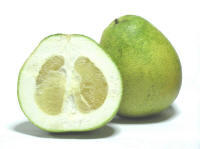 Pomelo
- The big boy of the citrus family, the fruits of the aptly-named Citrus
maxima can weigh up to 25 pounds (11 Kg), but smaller fruits are much more
common. Usually about the size of a small cantaloupe, the very thick yellow skin
surrounds segments of pink flesh which vary in juiciness and sweetness. Also
called shaddock (after the sea captain who introduced the trees to the West
Indies from their native Malaysia) and Chinese grapefruit, they have the same
culinary applications as grapefruits. Pomelo
- The big boy of the citrus family, the fruits of the aptly-named Citrus
maxima can weigh up to 25 pounds (11 Kg), but smaller fruits are much more
common. Usually about the size of a small cantaloupe, the very thick yellow skin
surrounds segments of pink flesh which vary in juiciness and sweetness. Also
called shaddock (after the sea captain who introduced the trees to the West
Indies from their native Malaysia) and Chinese grapefruit, they have the same
culinary applications as grapefruits.
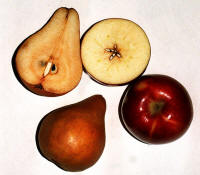 Pomes
- A group of fruits characterized by thin skins, firm flesh, and a central core
containing several small seeds called pips. Pomes are members of the family
Rosaceae and include apples, pears, quinces, and medlars. See individual
listings for details on each type of pome. Pomes
- A group of fruits characterized by thin skins, firm flesh, and a central core
containing several small seeds called pips. Pomes are members of the family
Rosaceae and include apples, pears, quinces, and medlars. See individual
listings for details on each type of pome.
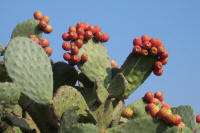 Prickly
Pear - The small barrel-shaped fruits of several species of Opuntia
cactus, prickly pears live up to their name with the small, sharp spines that
dot their skin. The flesh can be yellow, pink, orange, red, or garnet colored,
and has small edible seeds dispersed throughout. The thick peel is easily
removed-provided gloves or tongs are used to hold the potentially painful fruit.
They have a sweet, albeit nondescript, flavor. Prickly pears (also called cactus
pears, Indian pears, Indian figs, and barbary figs) are excellent for eating out
of hand and make wonderful jams and jellies. They are very popular in their
native range in the American Southwest, Mexico, Central and South America, and
are often available in supermarkets from late fall through early spring. Prickly
Pear - The small barrel-shaped fruits of several species of Opuntia
cactus, prickly pears live up to their name with the small, sharp spines that
dot their skin. The flesh can be yellow, pink, orange, red, or garnet colored,
and has small edible seeds dispersed throughout. The thick peel is easily
removed-provided gloves or tongs are used to hold the potentially painful fruit.
They have a sweet, albeit nondescript, flavor. Prickly pears (also called cactus
pears, Indian pears, Indian figs, and barbary figs) are excellent for eating out
of hand and make wonderful jams and jellies. They are very popular in their
native range in the American Southwest, Mexico, Central and South America, and
are often available in supermarkets from late fall through early spring.
Prune - See plum
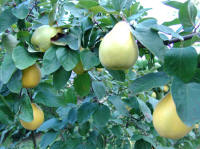 Quince
- Technically speaking, quinces are edible in their raw state but they have an
astringent, bitter taste and are always cooked. They have been grown for at
least 4,000 years, and were valued by the ancient Greeks and Romans for the
fragrance of their flowers as well as for their fruit. There are two species of
quinces in cultivation: one with round, apple-shaped fruits (Cydonia
vulgaris), and one with oblong, pear-shaped fruits (C. oblongata).
The fuzzy green or yellow skin gradually becomes smooth and the fruit matures.
They aren't as popular in the Americas as they are in Europe (Spain is a major
producer of dulce de membrillo, a thick, sweet quince paste), but are
sometimes available in the fall. Quince
- Technically speaking, quinces are edible in their raw state but they have an
astringent, bitter taste and are always cooked. They have been grown for at
least 4,000 years, and were valued by the ancient Greeks and Romans for the
fragrance of their flowers as well as for their fruit. There are two species of
quinces in cultivation: one with round, apple-shaped fruits (Cydonia
vulgaris), and one with oblong, pear-shaped fruits (C. oblongata).
The fuzzy green or yellow skin gradually becomes smooth and the fruit matures.
They aren't as popular in the Americas as they are in Europe (Spain is a major
producer of dulce de membrillo, a thick, sweet quince paste), but are
sometimes available in the fall.
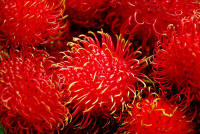 Rambutan
- Picture an exotic fruit from the planet Uranus and you might wind up with
something that looks like a rambutan-the golf-ball-sized fruits have a thick red
skin with dozens of long, soft, curled green spines pointing in all directions.
The sweet flesh is translucent white and surrounds a large, inedible seed,
similar to the litchi, a close relative. The Nephelium lappaceum tree
is native to Malaysia, and its bizarre fruits are rarely seen outside of
Southeast Asia. Rambutan
- Picture an exotic fruit from the planet Uranus and you might wind up with
something that looks like a rambutan-the golf-ball-sized fruits have a thick red
skin with dozens of long, soft, curled green spines pointing in all directions.
The sweet flesh is translucent white and surrounds a large, inedible seed,
similar to the litchi, a close relative. The Nephelium lappaceum tree
is native to Malaysia, and its bizarre fruits are rarely seen outside of
Southeast Asia.
.jpg) Raspberry
- It shouldn't come as too much of a surprise to anyone who has ever tangled
with a raspberry plant that they are members of the Rose family. Rubus
idaeus grows wild in temperate climates throughout the northern hemisphere,
and like most berries, was certainly enjoyed by our most distant ancestors. Many
people consider them the most flavorful of berries, and they rival strawberries
in worldwide production and popularity. Raspberry
- It shouldn't come as too much of a surprise to anyone who has ever tangled
with a raspberry plant that they are members of the Rose family. Rubus
idaeus grows wild in temperate climates throughout the northern hemisphere,
and like most berries, was certainly enjoyed by our most distant ancestors. Many
people consider them the most flavorful of berries, and they rival strawberries
in worldwide production and popularity.
Raspberries are compound fruits in that each individual drupelet
is a whole fruit with its own seed, and come in three categories according to
their color: yellow (or golden), black, and red, with the red berries being by
far the most common. Raspberries are distinguished from their close relative
blackberries by the fact that, when picked, the central pith of the fruit (the
hull) remains on the plant with raspberries (resulting in a hollow core in ripe
raspberries), and remains in the fruit in the case of blackberries (resulting in
a cottony mass in the core). Black raspberries and blackberries would be
indistinguishable to the layman if not for this convenient fact.
Raspberries do not ripen or become sweeter after that are picked
and should be eaten as soon as possible after buying. Rinse them very gently if
you must, but be prepared to bruise some berries if you do. Every raspberry
lover will tell you that they taste best raw and fresh from the bush (bramble,
if you want to get technical), but they are also used extensively in fillings
for pastries, to make jams, jellies, and syrups, and to flavor everything from
gelatin and candy to wines, ales, liqueurs, soft drinks, and vinegars.
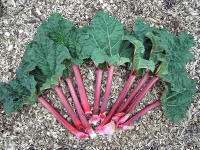 Rhubarb
- Although the fruits of many plants are treated as vegetables in the kitchen,
only one vegetable is habitually treated as a fruit. The stalks of the rhubarb
plant (Rheum rhabarbarum) must be sweetened during cooking and are
considered too tart to be eaten raw. Their startling sourness comes primarily
from oxalic acid, and the leaves of the plant contain such high concentrations
of oxalic acid that they are considered poisonous. The stalks range in color
from pale green through vibrant pink to deep red. Greenhouse-grown rhubarb,
which is more subdued in flavor and color than the field-grown crop, is
available nearly year round in many places, but many people prefer the
field-grown stalks for their more pronounced color and flavor, and therefore
confine their rhubarb purchases to early spring when rhubarb is at its best.
Rhubarb makes a wonderful filling for pies and tarts, and is often combined with
strawberries in the United States, and with ginger in the UK. Rhubarb
- Although the fruits of many plants are treated as vegetables in the kitchen,
only one vegetable is habitually treated as a fruit. The stalks of the rhubarb
plant (Rheum rhabarbarum) must be sweetened during cooking and are
considered too tart to be eaten raw. Their startling sourness comes primarily
from oxalic acid, and the leaves of the plant contain such high concentrations
of oxalic acid that they are considered poisonous. The stalks range in color
from pale green through vibrant pink to deep red. Greenhouse-grown rhubarb,
which is more subdued in flavor and color than the field-grown crop, is
available nearly year round in many places, but many people prefer the
field-grown stalks for their more pronounced color and flavor, and therefore
confine their rhubarb purchases to early spring when rhubarb is at its best.
Rhubarb makes a wonderful filling for pies and tarts, and is often combined with
strawberries in the United States, and with ginger in the UK.
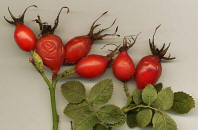 Rose
Hip - The round yellow, orange, or red fruits of rose bushes (Rosa
genus) are too bitter to be eaten raw, but when cooked with sugar they make
bitter-sweet jellies and syrups. They contain extremely hairy seeds which must
be removed before cooking. They are so high in vitamin C (a single rose hip can
contain twenty times as much as an orange) that they are sold in powdered form
in health food stores. Rose
Hip - The round yellow, orange, or red fruits of rose bushes (Rosa
genus) are too bitter to be eaten raw, but when cooked with sugar they make
bitter-sweet jellies and syrups. They contain extremely hairy seeds which must
be removed before cooking. They are so high in vitamin C (a single rose hip can
contain twenty times as much as an orange) that they are sold in powdered form
in health food stores.
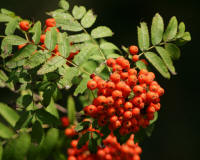 Rowanberry
- The small, brightly colored red-orange berries of the mountain ash tree (Sorbus
aucuparia) can't be eaten raw, but they make a bittersweet jelly and can be
used in syrups and liqueurs. Rowanberry
- The small, brightly colored red-orange berries of the mountain ash tree (Sorbus
aucuparia) can't be eaten raw, but they make a bittersweet jelly and can be
used in syrups and liqueurs.
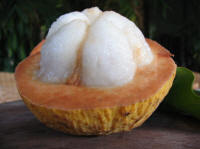 Santol
- The fruits of the Sandoricum koetjape tree of Southeast Asia come in
two varieties: sweet, and sour. Both are medium-sized round fruits with a tough
brown outer skin surrounding five segments of white pulp. Some people liken the
flavor to peaches, and they can be eaten out of hand, candied, or pickled. Santol
- The fruits of the Sandoricum koetjape tree of Southeast Asia come in
two varieties: sweet, and sour. Both are medium-sized round fruits with a tough
brown outer skin surrounding five segments of white pulp. Some people liken the
flavor to peaches, and they can be eaten out of hand, candied, or pickled.
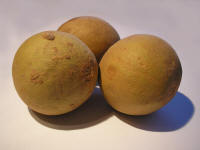 Sapodilla
- With a flavor that people have likened to vanilla-flavored banana custard and
brown sugar, sapodillas ought to be more popular than they are. Unremarkable in
appearance, the small, egg-shaped fruits are light brown in color with a fuzzy
exterior. The inside reveals sweet, amber-colored flesh with inedible black
seeds. They are best eaten raw when ripe (unripe fruit has a mouth-puckering
effect), scooped out of the skin with a spoon, but they are also used in ice
cream, custards, and as a filling for pastries. The sap of the same tree (Achras
sapote, a native of Central America) was known as chicle to the Maya and is
the main ingredient in chewing gum. Sapodilla
- With a flavor that people have likened to vanilla-flavored banana custard and
brown sugar, sapodillas ought to be more popular than they are. Unremarkable in
appearance, the small, egg-shaped fruits are light brown in color with a fuzzy
exterior. The inside reveals sweet, amber-colored flesh with inedible black
seeds. They are best eaten raw when ripe (unripe fruit has a mouth-puckering
effect), scooped out of the skin with a spoon, but they are also used in ice
cream, custards, and as a filling for pastries. The sap of the same tree (Achras
sapote, a native of Central America) was known as chicle to the Maya and is
the main ingredient in chewing gum.
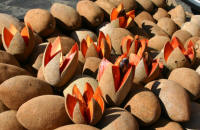 Sapote
- These ovoid fruits, about the size of a small orange, have a skin that ranges
in color from chartreuse to bright yellow, and flesh that ranges in color from
ivory to salmon. The soft flesh, which surrounds 3 to 5 inedible seeds, has a
flavor reminiscent of peach, avocado, and vanilla. Native to Central America and
the Caribbean, the fruits of the Pouteria sapota tree are also known as
white sapotes and are sometimes available in specialty produce markets in the
fall. Sapote
- These ovoid fruits, about the size of a small orange, have a skin that ranges
in color from chartreuse to bright yellow, and flesh that ranges in color from
ivory to salmon. The soft flesh, which surrounds 3 to 5 inedible seeds, has a
flavor reminiscent of peach, avocado, and vanilla. Native to Central America and
the Caribbean, the fruits of the Pouteria sapota tree are also known as
white sapotes and are sometimes available in specialty produce markets in the
fall.
Satsuma - See tangerine
Shaddock - See pomelo
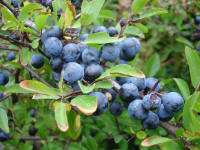 Sloe
- These tiny members of the plum family (Prunus spinosa) grow on the
blackthorn shrub which grows wild throughout Europe. The small purple fruits
look like miniature plums, but the flesh is so astringent that they are inedible
raw, and they are best picked when fully ripe and after the first frost of the
year. They are made into jams and jellies, but their primary claim to fame is as
the flavoring in sloe gin. Sloe
- These tiny members of the plum family (Prunus spinosa) grow on the
blackthorn shrub which grows wild throughout Europe. The small purple fruits
look like miniature plums, but the flesh is so astringent that they are inedible
raw, and they are best picked when fully ripe and after the first frost of the
year. They are made into jams and jellies, but their primary claim to fame is as
the flavoring in sloe gin.
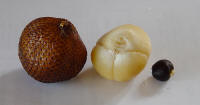 Snake
Fruit - With a thin, scaly brown skin that looks just like reptile skin, it's no
secret how the fruits also known as salaks came by their more common name. The
pear-shaped fruits of the Zalacci edulis tree of Southeast Asia are
about the size of a large hen's egg. The ivory-toned flesh surrounds a large
inedible seed in each of four segments. Almost flavorless, or with a slight hint
of apples, the crisp flesh is often added to fruit salads and can be poached in
syrup. Snake
Fruit - With a thin, scaly brown skin that looks just like reptile skin, it's no
secret how the fruits also known as salaks came by their more common name. The
pear-shaped fruits of the Zalacci edulis tree of Southeast Asia are
about the size of a large hen's egg. The ivory-toned flesh surrounds a large
inedible seed in each of four segments. Almost flavorless, or with a slight hint
of apples, the crisp flesh is often added to fruit salads and can be poached in
syrup.
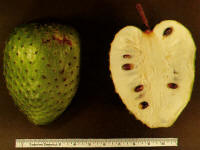 Soursop
- Soursops are the biggest member of the cherimoya family with fruits often
reaching 10 pounds (4.5 Kg) in weight. The Annona muricata tree is
native to the Caribbean region, and its fruits are rarely encountered far from
their native range. Like their cousins, they have a thin, soft skin and are
divided into hundreds of segments containing soft, ivory-colored flesh
surrounding large inedible seeds. The flesh is sweet and tart and often compared
to pineapples in flavor. Also called prickly custard apples (for the short soft
spines on their skin) and bullock's hearts. Soursop
- Soursops are the biggest member of the cherimoya family with fruits often
reaching 10 pounds (4.5 Kg) in weight. The Annona muricata tree is
native to the Caribbean region, and its fruits are rarely encountered far from
their native range. Like their cousins, they have a thin, soft skin and are
divided into hundreds of segments containing soft, ivory-colored flesh
surrounding large inedible seeds. The flesh is sweet and tart and often compared
to pineapples in flavor. Also called prickly custard apples (for the short soft
spines on their skin) and bullock's hearts.
Star Fruit - See carambola
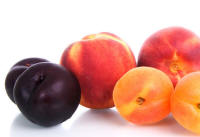 Stone
Fruits - A group of fruits characterized by thin skins, soft, juicy flesh, and a
single woody pit called a stone. Stone fruits, also known as drupes, are all
members of the genus Prunus and include plums, peaches, apricots, and
cherries. See individual listings for details on each type of stone fruit. Stone
Fruits - A group of fruits characterized by thin skins, soft, juicy flesh, and a
single woody pit called a stone. Stone fruits, also known as drupes, are all
members of the genus Prunus and include plums, peaches, apricots, and
cherries. See individual listings for details on each type of stone fruit.
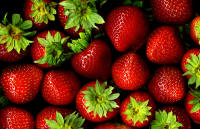 Strawberry
- Trivia experts know that strawberries have the distinction of being the only
fruit that bears its seeds on the outside, but this isn't exactly true. The
small, hard "seeds" are actually the fruits (called achenes) of the plants of
the Fragaria genus, and the fleshy red organ they sit on is actually
the swollen base of the flower and not the ovary. Strawberries grow wild in
temperate climates around the world and have been prized for their sweet flavor
since prehistoric times. Strawberry
- Trivia experts know that strawberries have the distinction of being the only
fruit that bears its seeds on the outside, but this isn't exactly true. The
small, hard "seeds" are actually the fruits (called achenes) of the plants of
the Fragaria genus, and the fleshy red organ they sit on is actually
the swollen base of the flower and not the ovary. Strawberries grow wild in
temperate climates around the world and have been prized for their sweet flavor
since prehistoric times.
Modern strawberries are the result of a cross between the wild
Virginia strawberry of North America and the pine strawberry from South America,
and hundreds of varieties are available year round just about everywhere thanks
to greenhouse production. In spite of this near universal availability,
strawberry lovers know that they never taste better than when they're in season
in the spring. Wild strawberries are usually called by their French name fraises
des bois ("strawberries of the woods") and are popular and widely available in
Europe. They tend to be smaller than modern strawberries and are often yellow or
pink rather than their trademark red, and have a flavor that is usually
described as intense.
Strawberries do not improve after being picked so it is best to
buy the ripest berries available and to eat them as soon as possible. Color and
size are poor indicators of quality because smaller, yellowish strawberries
often have a sweeter, more pronounced flavor-always sample one before you buy if
your market will allow. Strawberries absorb water readily so don't wash them
until you eat them, if at all-sometimes a gentle wipe is all that's needed. If
you can't eat them right away, store them loosely wrapped in paper towels in an
airtight container in the refrigerator for up to two days, and always let them
return to room temperature before serving them.
Strawberries are available in almost every conceivable form,
including frozen, dried, candied, pureed, and preserved in jams and jellies, but
they are best when they're fresh. Fresh ripe strawberries are traditionally
served with nothing more than a dollop of thick cream and maybe a sprinkling of
sugar, but a grinding of black pepper or a few drops of balsamic vinegar
complement the unique sweet-tart flavor of strawberries beautifully.
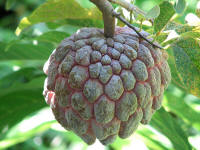 Sweetsop
- Like its close cousin the cherimoya, sweetsops (Annona squamosa) are
irregular, lumpy fruits with yellowish-green skins and soft, custard-like
ivory-colored flesh surrounding large black seeds arranged in segments. It has a
pronounced clove-like flavor and is almost always eaten raw. They are grown
commercially in Florida and California yet are rarely available outside of these
areas. These Central American natives are also known as sugar apples, and are
often confused with cherimoyas (which are also called custard apples). Sweetsop
- Like its close cousin the cherimoya, sweetsops (Annona squamosa) are
irregular, lumpy fruits with yellowish-green skins and soft, custard-like
ivory-colored flesh surrounding large black seeds arranged in segments. It has a
pronounced clove-like flavor and is almost always eaten raw. They are grown
commercially in Florida and California yet are rarely available outside of these
areas. These Central American natives are also known as sugar apples, and are
often confused with cherimoyas (which are also called custard apples).
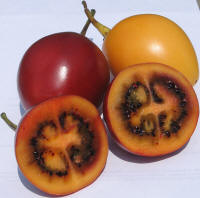 Tamarillo
- It's ironic that this South American fruit is more popular in parts of Asia,
Australia, and New Zealand than in North America. Also called tree tomatoes, the
egg-shaped berries of the Cyphomandra betecea plant, a relative of
eggplants and tomatoes, have a smooth skin ranging from purple to yellow,
although most that reach the market are a bright tomato-red. The tart flesh
surrounds numerous black seeds and needs the sweetness of added sugar to be
palatable. Don't try to eat the skin which is extremely bitter. Tamarillos can
be used to add a distinctive tartness to jams, jellies, chutneys, and sauces. Tamarillo
- It's ironic that this South American fruit is more popular in parts of Asia,
Australia, and New Zealand than in North America. Also called tree tomatoes, the
egg-shaped berries of the Cyphomandra betecea plant, a relative of
eggplants and tomatoes, have a smooth skin ranging from purple to yellow,
although most that reach the market are a bright tomato-red. The tart flesh
surrounds numerous black seeds and needs the sweetness of added sugar to be
palatable. Don't try to eat the skin which is extremely bitter. Tamarillos can
be used to add a distinctive tartness to jams, jellies, chutneys, and sauces.
Tangelo - See tangerine
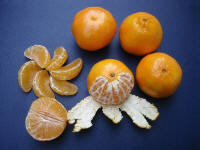 Tangerine
- This large family of citrus fruits is characterized by small fruits with thin
skin that is easily detached from the flesh. Also known as mandarin oranges (or
just mandarins) in much of the English-speaking world, there are several
varieties on the market whose names are often used interchangeably-and
inaccurately. Tangerine
- This large family of citrus fruits is characterized by small fruits with thin
skin that is easily detached from the flesh. Also known as mandarin oranges (or
just mandarins) in much of the English-speaking world, there are several
varieties on the market whose names are often used interchangeably-and
inaccurately.
Clementines are true tangerines (Citrus reticulata) and
are the most commonly found variety in most areas. Satsumas, also true
tangerines, are native to Japan and are sometimes available fresh in the United
States, but are most likely to be found canned and labeled as mandarin orange
segments. Ortaniques, grown mainly in Jamaica, are believed to be a cross
between a satsuma and an ugli. Tangelos are crosses between tangerines and
grapefruits and are noteworthy for their orange-like flavor. Minneolas, also the
hybrid of tangerines and grapefruits, are recognizable for the lump at the stem
end of the fruit and are seedless, sweet, and juicy.
Tangerines are usually eaten out of hand or added to salads, and
canned mandarin oranges are a common ingredient in many gelatin salads and
desserts. The dried peel is a standard seasoning in China where it is used in
both sweet and savory dishes.
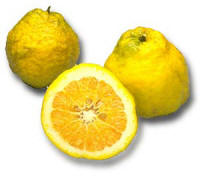 Ugli
Fruit - Pronounced OO-glee, no matter how you say it, the thick, mottled skin of
this hybrid citrus will never win it any beauty contests. Believed to be a cross
between a grapefruit (or possibly a pomelo) and a tangerine (or possibly an
orange), the fruits are usually about the size of a grapefruit and can be
treated as such in the kitchen. The flavor is like a sweet grapefruit with a
hint of orange. Ugli
Fruit - Pronounced OO-glee, no matter how you say it, the thick, mottled skin of
this hybrid citrus will never win it any beauty contests. Believed to be a cross
between a grapefruit (or possibly a pomelo) and a tangerine (or possibly an
orange), the fruits are usually about the size of a grapefruit and can be
treated as such in the kitchen. The flavor is like a sweet grapefruit with a
hint of orange.
 Watermelon
- One of the few commercial fruits native to Africa, the Citrullus lanatus
vine grows wild throughout much of southern Africa. With fruits weighing less
than five pounds (2.2 Kg) and more than 40 pounds (18 Kg) or even larger, they
are also one of the most variable in size. Their skins are striped in shades of
green, and the watery flesh can be almost white, bright yellow, vivid pink, or
cherry red. The large edible seeds can be black, brown, white, or mottled, and
selective breeding has produced "seedless" varieties with seeds that never
develop beyond their soft white embryonic stage. Choose watermelons with a
yellow patch that indicates where it was in contact with the ground-a white or
green patch indicates an under-ripe melon. In spite of their status as a fixture
at Fourth of July cookouts, more watermelons are grown and consumed in China
than anywhere else. All parts of the watermelon are edible; the seeds can be
roasted or fried, and the rind is often pickled and served as a condiment.
Watermelons should be stored in the refrigerator and served chilled. The flavor
is delicate (or even drab according to some), but people everywhere know that
nothing tastes better than a slice of cold watermelon on a hot summer day. Watermelon
- One of the few commercial fruits native to Africa, the Citrullus lanatus
vine grows wild throughout much of southern Africa. With fruits weighing less
than five pounds (2.2 Kg) and more than 40 pounds (18 Kg) or even larger, they
are also one of the most variable in size. Their skins are striped in shades of
green, and the watery flesh can be almost white, bright yellow, vivid pink, or
cherry red. The large edible seeds can be black, brown, white, or mottled, and
selective breeding has produced "seedless" varieties with seeds that never
develop beyond their soft white embryonic stage. Choose watermelons with a
yellow patch that indicates where it was in contact with the ground-a white or
green patch indicates an under-ripe melon. In spite of their status as a fixture
at Fourth of July cookouts, more watermelons are grown and consumed in China
than anywhere else. All parts of the watermelon are edible; the seeds can be
roasted or fried, and the rind is often pickled and served as a condiment.
Watermelons should be stored in the refrigerator and served chilled. The flavor
is delicate (or even drab according to some), but people everywhere know that
nothing tastes better than a slice of cold watermelon on a hot summer day.
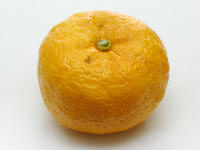 Yuzu
- This small citrus is native to Tibet and China. About the size of a small
tangerine, the fruits of the Citrus aurantium tree are greenish-yellow
inside and out, and contain many small seeds. The juice and the rind are used in
Japanese cooking, and fresh yuzu can sometimes be found in Asian specialty
markets. Bottled yuzu juice is a popular ingredient in many Japanese sauces and
marinades, and is becoming more widely available outside of Japan. Yuzu
- This small citrus is native to Tibet and China. About the size of a small
tangerine, the fruits of the Citrus aurantium tree are greenish-yellow
inside and out, and contain many small seeds. The juice and the rind are used in
Japanese cooking, and fresh yuzu can sometimes be found in Asian specialty
markets. Bottled yuzu juice is a popular ingredient in many Japanese sauces and
marinades, and is becoming more widely available outside of Japan.
©
2005 Worldwide Recipes. All
rights reserved.
|



 Joe
Barkson has been writing and publishing under the pen name "The
Chef at Worldwide Recipes" since 1998. He came to food writing
late in life following checkered careers in computer marketing,
graphic design, and teaching high school Spanish. A lifelong
interest in food and cooking ("I've been eating since I was a
baby," he is fond of saying) was nurtured by extensive
international travel during his formative years, and this
accounts for the emphasis on world cuisine in his choice of
recipes and themes. Twice married and currently happily single,
he lives in rural Georgia with a hyperkinetic schipperke that
answers to Cooky when the mood strikes him.
Joe
Barkson has been writing and publishing under the pen name "The
Chef at Worldwide Recipes" since 1998. He came to food writing
late in life following checkered careers in computer marketing,
graphic design, and teaching high school Spanish. A lifelong
interest in food and cooking ("I've been eating since I was a
baby," he is fond of saying) was nurtured by extensive
international travel during his formative years, and this
accounts for the emphasis on world cuisine in his choice of
recipes and themes. Twice married and currently happily single,
he lives in rural Georgia with a hyperkinetic schipperke that
answers to Cooky when the mood strikes him.